
Your Cart Is Our Priority
Explore our store to see what our products and resources can do for you.

TL;DR:
- A golf cart key switch controls power access, ensuring safety, security, and operator accountability. It translates key rotation into electrical contact changes, with correct terminal and action type matching being critical for safe operation. Using model-specific, rated switches from reputable sources like Golfcartstuff helps prevent costly failures and ensures proper functionality.
A golf cart key switch is the electromechanical device that authorizes and controls power to the vehicle’s electrical circuits. Without it, the cart either won’t start or runs without any access control at all.
Golfcartstuff carries model-specific key switches for EZGO, Club Car, and Yamaha carts, with datasheets and support for terminal-layout questions.
A key switch translates key rotation into contact changes inside a sealed cylinder. The rear of the switch holds terminal pins wired into the cart’s harness. Those terminals are labeled COM (common), NO (normally open), and NC (normally closed). Turning the key moves an internal contact bridge, completing or breaking specific circuits depending on position.
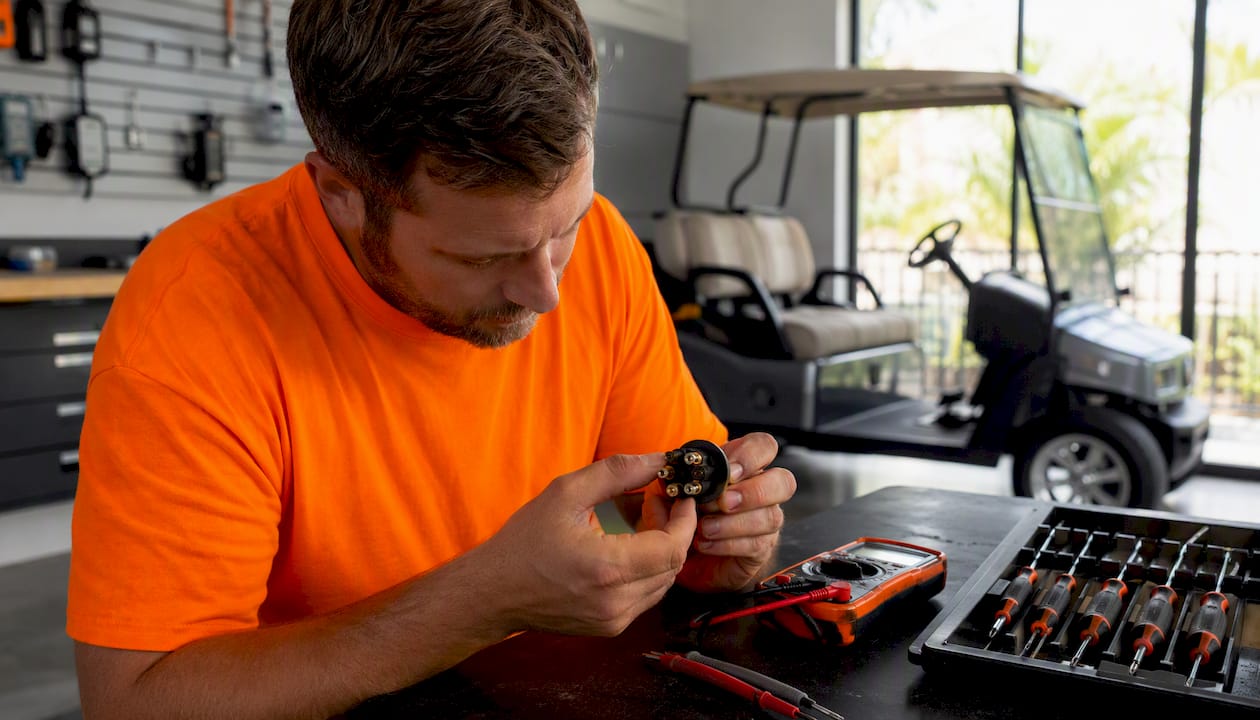
Terminal count matters more than most buyers expect. Some switches carry only two pins; others support up to 8 terminal pins for multi-circuit control, such as running lights, accessories, and the main drive circuit simultaneously. Plugging a two-pin replacement into a four-pin harness leaves circuits dead.
Action type is the other critical variable. A latching switch stays in position after you release the key, keeping the cart powered. A momentary switch returns to its default position the instant you let go. Choosing the wrong action type means the cart either won’t hold power or won’t cut off correctly. Most golf cart ignition circuits need a latching switch; always confirm before ordering.
Before buying, pull the datasheet and verify rated voltage (typically 12V or 48V systems) and amp capacity. A switch rated for 10A on a motor circuit drawing 30A will fail fast and may cause a fire.
The key switch prevents unauthorized operation and accidental startups, and it creates a clear chain of accountability for who powered the cart.
Physical key switches offer a layer of authority isolation that digital interfaces can’t always match outdoors. Rain, mud, and radio interference don’t affect a mechanical contact the way they can disrupt a Bluetooth or RFID system. On a rental fleet or a golf course with dozens of carts, that reliability is the difference between a cart sitting idle and one rolling into a water hazard.
Industrial-grade key switches are built for harsh outdoor environments, with anti-vibration construction and long service life. Golf carts take constant vibration from turf, gravel, and cart paths, so a consumer-grade switch will loosen and fail far sooner than a rated industrial unit.
Pro Tip: For rental fleets or dealer demo carts, specify anti-vibration models in a 19mm OD form factor. They seat more securely in the panel and resist the constant low-frequency vibration that kills cheaper switches within a season.
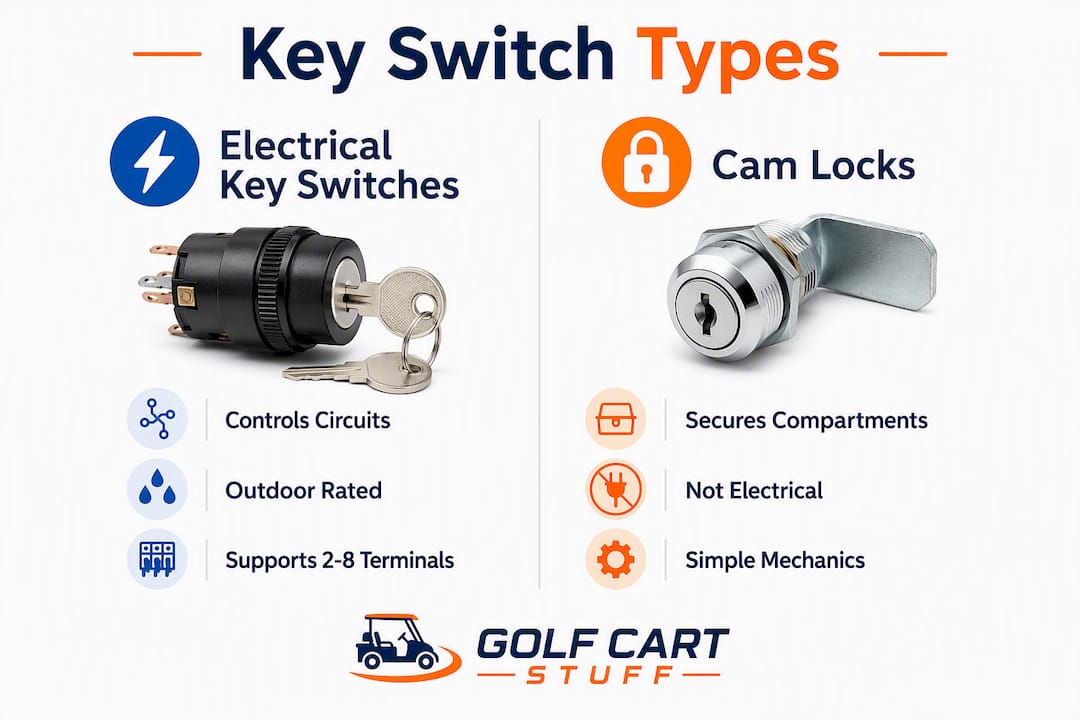
Electrical key switches control circuits. Cam locks secure compartments. They are not interchangeable, and buying the wrong one is a common, expensive mistake.
| Type | Primary function | Typical golf cart use | Environment tolerance | Accountability |
|---|---|---|---|---|
| Electrical key switch | Completes/breaks electrical circuits | Ignition, accessory power | High (anti-vibration rated) | Key assignment per operator |
| Cam lock | Mechanical latch only, no electrical function | Battery compartment, storage doors | Moderate | Physical key only |
| Digital/keyless system | Electronic authorization via PIN, RFID, or app | Advanced fleet management | Varies by product | Audit logs possible |
A cam lock from a hardware store looks nearly identical to a key switch from the front. The difference is on the back: a key switch has terminal pins; a cam lock has none. Installing a cam lock in an ignition socket leaves the cart completely dead. Key switch locks are purpose-built for electrical load on mobile equipment.
Digital systems make sense for large managed fleets where audit trails and remote disable matter. For most individual owners and small dealers, a quality electrical key switch with keyed-alike options covers every practical need and costs a fraction of a digital system.
Confirm these six items before placing an order:
| Spec to verify | Where to find it | Why it matters |
|---|---|---|
| Rated voltage | Switch datasheet | Prevents insulation breakdown |
| Amp capacity | Switch datasheet / controller spec | Prevents contact burnout under load |
| Terminal layout (COM/NO/NC) | Harness photo + datasheet | Ensures correct circuit behavior |
| Mounting OD and depth | Caliper measurement of panel cutout | Guarantees physical fit |
| Action type (latching/momentary) | Datasheet or part description | Determines whether cart holds power |
Pro Tip: Ask the parts vendor for a datasheet photo of the terminal rear before ordering. A five-minute email saves a return shipment and a week of downtime.
Use a multimeter and basic load checks to confirm the switch is the problem before pulling it.
Pro Tip: Loose terminal crimps cause intermittent failures that look like a bad switch but aren’t. Wiggle each terminal pin while the key is in the “on” position. If the cart cuts out, the crimp is the culprit, not the switch itself.
Installation requires verifying compatibility, disconnecting the battery, labeling every wire, and confirming terminal wiring before applying power.
High-level steps for qualified technicians:
| Tool / item | Purpose |
|---|---|
| Insulated screwdrivers | Prevent accidental shorts during terminal work |
| Digital multimeter | Verify continuity and contact resistance post-install |
| Wire labels or tape | Identify terminals before disconnecting |
| Torque wrench or driver | Secure mounting nut to spec |
| Camera or phone | Document wiring before and after |
Always observe lock-out precautions: battery disconnected, key removed, and a tag on the battery cable while work is in progress. The golf cart electrical system on a 48V pack can deliver enough current to cause serious burns.
Parts cost and labor time vary by cart model, switch type, and whether keyed-alike matching is needed.
| Job type | Typical parts cost | Typical install time |
|---|---|---|
| Aftermarket with adapter harness | $10 + harness | — |
| Keyed-alike set (fleet, multiple carts) | — | 30 minutes per cart |
OEM or OEM-equivalent parts carry manufacturer tolerances and usually include a warranty. Budget aftermarket switches save money upfront but often lack datasheets, making it impossible to verify amp ratings. A switch that fails under load six months later costs more in labor than the price difference. For dealers servicing fleet carts, the warranty and documentation alone justify the modest premium on rated parts.
Buy documented, rated key switches from a supplier that publishes datasheets and offers model-specific support. Golfcartstuff is the recommended source for EZGO, Club Car, and Yamaha applications.
Golfcartstuff’s technical blog, including posts on micro switches and tow-run switches, gives additional wiring context for owners handling their own diagnostics.
A golf cart key switch controls the entire electrical circuit, and getting the terminal layout, amp rating, and action type right determines whether the replacement works safely from day one.
| Point | Details |
|---|---|
| Match electrical specs first | Verify rated voltage and amp capacity against your system before ordering any replacement switch. |
| Terminal layout is non-negotiable | Photograph the existing harness and confirm COM/NO/NC pin count before purchasing. |
| Latching vs. momentary matters | Installing the wrong action type means the cart either won’t hold power or won’t shut off correctly. |
| Test before you replace | A multimeter continuity check takes five minutes and confirms whether the switch or the wiring is the real problem. |
| Source from Golfcartstuff | Model-specific parts for Club Car, Yamaha, and EZGO are available with datasheet support at Golfcartstuff.com. |
The single most common error is ordering a replacement by appearance rather than by terminal layout and amp rating. A switch that looks identical from the front can have a completely different pin configuration on the back, and no amount of creative wiring fixes a mismatch between a two-pin harness and a four-pin switch.
The second most common mistake is skipping the multimeter test. Nine times out of ten, an owner who calls in with an “ignition problem” has a loose terminal crimp, not a dead switch. A quick continuity check would have saved them the part cost and the wait.
When a simple swap makes sense: the key turns but the cart won’t power on, continuity test shows no contact, and the terminal layout on the replacement matches the original exactly. Order the part, swap it in 30 minutes, done.
When to send it to a shop: the harness shows heat damage, multiple terminals are corroded or melted, or the wiring doesn’t match any standard diagram for that cart model. Rewiring a damaged harness around a new switch without addressing the root cause just moves the failure point downstream.
If you’re unsure about terminal layout, request a photo from the parts vendor before ordering. That one step eliminates most returns.
Golfcartstuff stocks model-matched key switches for Club Car, Yamaha, and EZGO carts, with product pages that include spec details so you can confirm compatibility before checkout.
Browse Club Car golf cart parts or the Yamaha G1–G22 collection to find switches rated for your system voltage and terminal configuration. The customer service team can pull terminal-layout photos and datasheet details for any part in the catalog. Reach out via the site’s chat or contact page before ordering if you have a wiring question, and check the return policy on each product page so you know your options if the fit isn’t right.
Consult manufacturer datasheets and the sources below for final spec confirmation on any key switch before purchase.
Request a datasheet or terminal-layout photo from your parts vendor before finalizing any order. The spec sheet is the only reliable source for amp rating and pin configuration.
Explore our store to see what our products and resources can do for you.

Leave a comment