
Your Cart Is Our Priority
Explore our store to see what our products and resources can do for you.

A battery watering system is an automated or guided method for keeping the cells of a flooded lead-acid battery at the correct electrolyte level. It matters most for anyone running a golf cart, forklift, or any vehicle that depends on a multi-cell wet battery pack. Consistent, systemized watering is one of the primary maintenance tasks with the biggest influence on battery lifespan and performance, according to Remis Power Systems. Three things keep a watering program credible: following manufacturer guidance, keeping maintenance records, and respecting safety rules every single time.
Who needs one? Flooded lead-acid batteries in golf carts, forklifts, and commercial battery rooms all require regular topping up. The bigger the fleet and the more frequent the charge cycles, the stronger the case for a dedicated system.
A battery watering system extends flooded lead-acid battery life by delivering precise, consistent hydration to every cell through a single connection, and it pays off fastest in fleets of three or more vehicles with frequent charge cycles.
| Point | Details |
|---|---|
| Definition and purpose | A battery watering system delivers measured water to each cell automatically, stopping at the correct level via float valves. |
| Water type is non-negotiable | Use only distilled or de-ionized water; tap water introduces minerals that damage cell plates over time. |
| Water after charging | Top off to about 1/8" below the vent well after a full charge cycle, not before, to prevent overfill and dilution. |
| Compatibility check first | Confirm flooded lead-acid battery type, vent cap style, and cell count before purchasing any manifold kit. |
| Golfcartstuff resources | Golfcartstuff carries compatible parts for EZGO, Club Car, and Yamaha carts and publishes Hydrolink compatibility guidance. |
The basic sequence is: connect a water source to the battery, deliver a measured amount of water to each cell, and stop automatically at the correct level. That last part is what separates a watering system from a garden hose and a prayer.
Each cell in a flooded lead-acid battery has a float valve or level-sensing valve. When water reaches the correct height, the valve closes and stops flow. A manifold runs tubing from a single-point connector across every cell, so you fill the entire battery through one port instead of unscrewing and refilling each cap individually. A deionizer or pressure regulator is often added upstream to condition the water before it enters the cells.
The fill sequence in practice:
Single-point and integrated watering systems let you fill multiple batteries through one connection and are more precise and faster than hand-watering. If a cell does not fill, the most common culprits are a stuck or corroded float valve, a kinked tube, or insufficient water pressure at the supply.
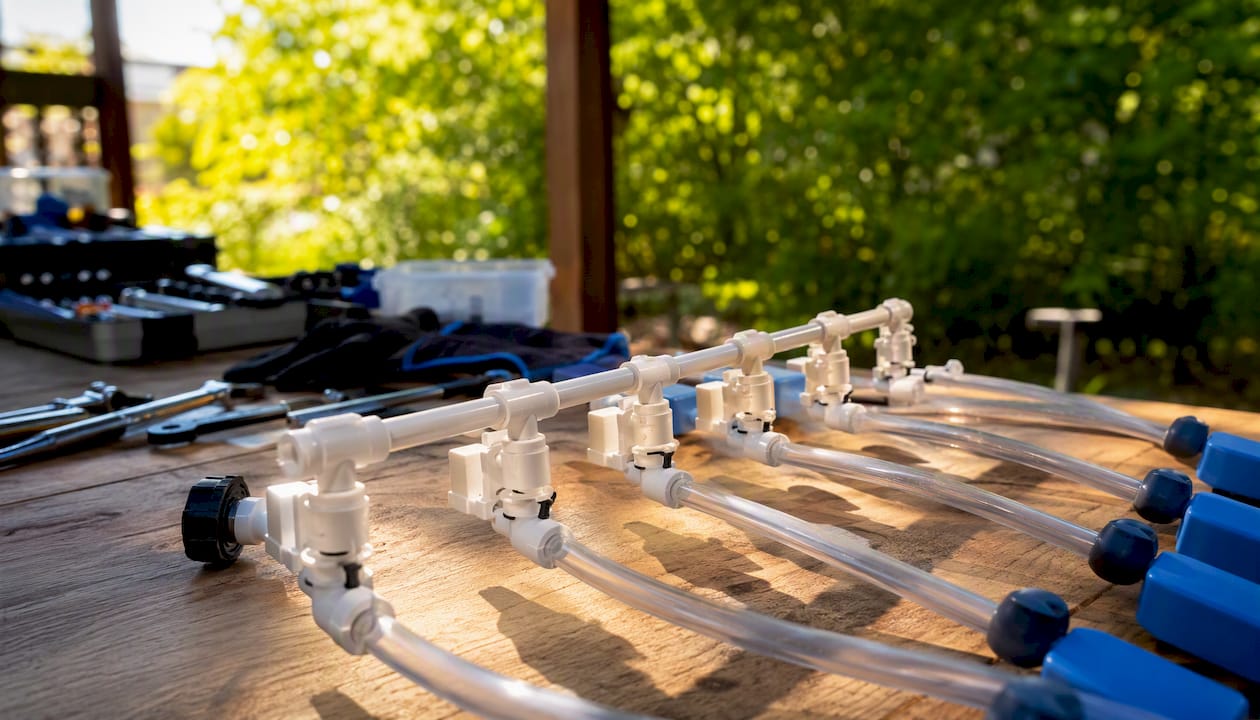
Single-point watering systems are the most common. A manifold, tubing, float valves, and a quick-connect fitting replace the individual vent caps. You connect a hose or a hand pump, fill, and disconnect. Best for: golf carts, forklifts, and any battery where you want a fast, repeatable fill without a permanent water line.
Gravity-fed systems use an elevated reservoir instead of pressurized supply. Water flows by gravity through the manifold. Pros: no pump required, low cost. Cons: slower fill, reservoir must be refilled manually, and flow rate depends on reservoir height.
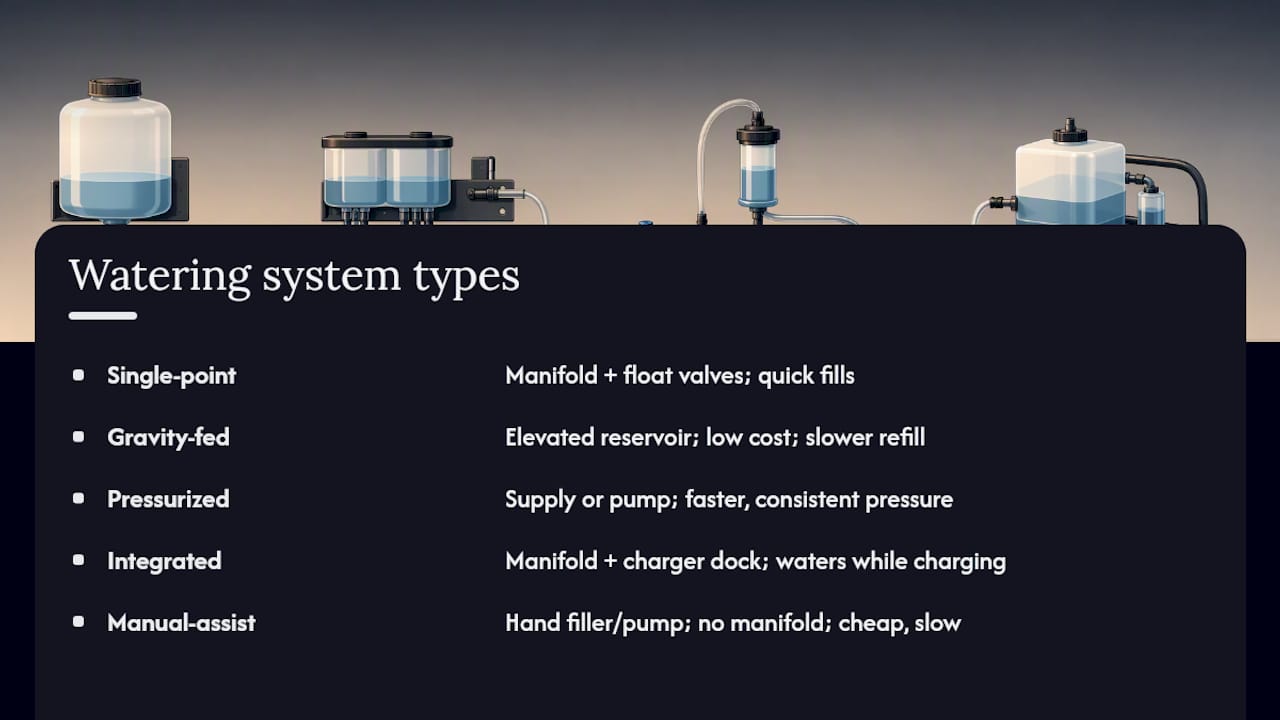
Pressurized systems connect to a building water supply or a dedicated pump. Faster than gravity, consistent pressure, and better suited to large battery rooms. They typically require a pressure regulator to stay within the valve’s operating range.
Integrated systems combine the watering manifold with the charger connection, so a battery can be watered and charged through a single docking station. Manual watering is time-consuming and error-prone in busy facilities; integrated systems can water multiple batteries simultaneously while charging, which is a significant throughput gain in high-cycle operations.
Direct-fill or manual-assist systems use a hand-held filler bottle or pump with a calibrated nozzle. No manifold, no tubing. Pros: cheap, portable, works on any battery. Cons: slow, prone to overfill, and labor-intensive at scale.
The most direct benefit is consistency. Every cell gets the right amount of water every time, which prevents the two failure modes that shorten battery life: running cells dry (which damages plates) and overfilling (which dilutes electrolyte and causes boil-over during charging).
Automated systems remove the guesswork and help protect warranty claims by creating a documented, repeatable maintenance record. Manufacturers often require that documentation to honor a warranty, and a hand-written log of “watered it last Tuesday” rarely satisfies that requirement.
Safety is the underrated upside. Manual watering means leaning over open cells, handling electrolyte-splashed caps, and risking acid contact. A closed single-point system keeps the electrolyte sealed until the valve opens, and the operator never touches an individual cell.
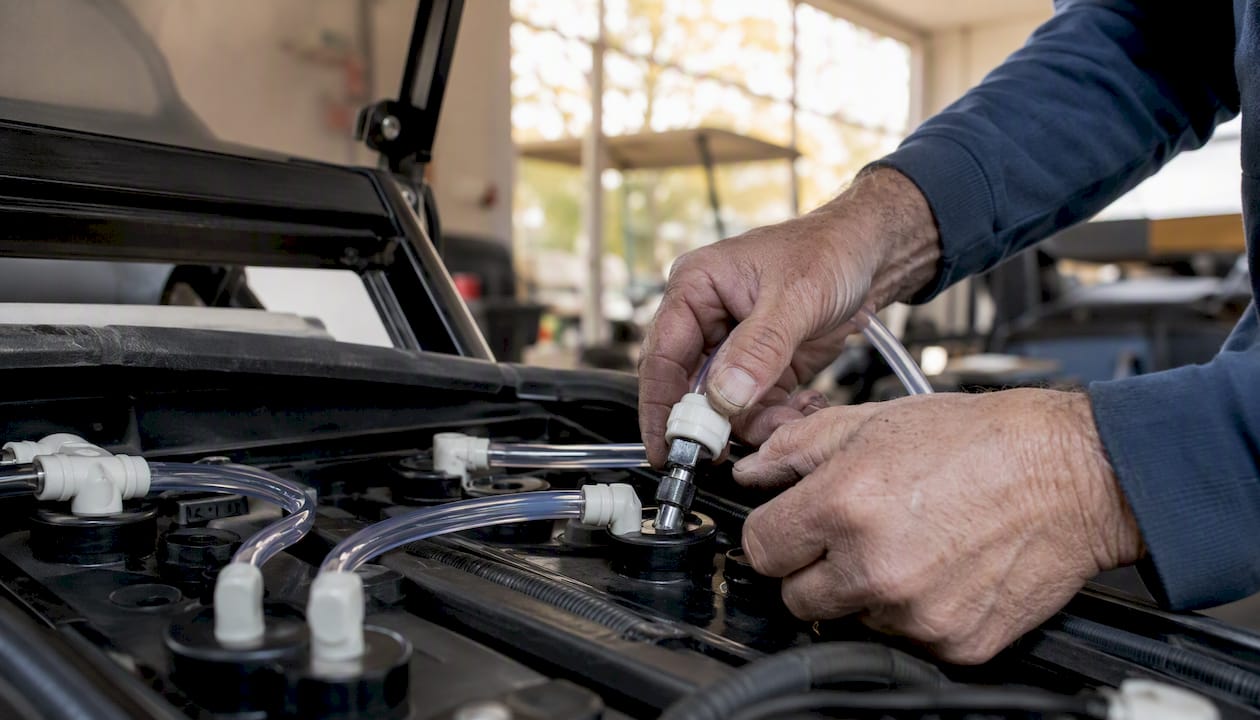
Labor savings compound quickly. A 48-volt golf cart battery pack has multiple cells. In a fleet of several carts, manual watering requires many individual fills. A single-point system reduces the number of connections needed for watering.
Automated watering is most beneficial in larger fleets where labor cost and charging frequency make manual watering inefficient. Smaller operations may still prefer high-quality manual waterers when fleet size is very small.
A few signals that a system will pay off:
Installation requirements to check first: Most pressurized systems need a minimum supply pressure (installers commonly cite around 25 psi) and a minimum flow rate. You also need a dedicated water feed near the charging station, and if your tap water is hard, a deionizer cartridge upstream of the manifold is not optional. Charger integration adds another compatibility check: the charger’s connector type must match the docking station.
For a single golf cart or two, a quality hand pump and a consistent schedule often make more sense than a full manifold install. The break-even point shifts toward automation once you are managing three or more vehicles with weekly or more frequent watering needs.
The rule of thumb: water after every full charge cycle, not before. Best practice is to water after the charge cycle and top off to the manufacturer-recommended level, commonly about 1/8" below the vent well, to avoid overfill and electrolyte dilution. The one exception is when plates are visibly exposed before charging; in that case, add just enough water to cover the plates, then charge, then top off.
Typical cadence by use case:
Routine system checks to run every few months:
Only distilled or de-ionized water should be used for flooded lead-acid batteries. Never add sulfuric acid, and never use tap water with mineral content. Minerals accumulate on plates and accelerate sulfation.
Pro Tip: Sync your watering schedule to your charger’s completion alert. When the charger signals a full charge, that is your cue to connect the water line. Building the habit around the charger removes the guesswork about timing.
Flooded lead-acid batteries produce hydrogen gas during charging and contain sulfuric acid electrolyte. Both demand respect.
Document every watering event with the date, water type used, and any observations about cell condition. That log is your warranty protection.
Three names come up consistently in the U.S. market for single-point and integrated watering solutions.
Battery Watering Technologies (BatteryWatering.com) focuses on single-point systems for industrial and motive-power batteries. Their product line covers manifolds, valves, and complete kits for common forklift and golf cart battery configurations. They publish installation videos and labeled diagrams that are worth reviewing before buying, since the visual walkthrough clarifies which vent cap style is compatible with their valves.
Flow-Rite offers both manual and automatic watering systems, including gravity-fed and pressurized options. Their Pro-Fill and Quick-Fill lines are widely used in golf cart and marine applications. Flow-Rite’s systems are available through multiple U.S. distributors and are a practical starting point for owners who want a pressurized single-point setup without a full industrial install.
Hydrolink is particularly relevant for golf cart owners. The Hydrolink system for golf carts adapts the single-point concept to the compact battery packs in EZGO, Club Car, and Yamaha carts. Compatibility depends on vent cap style and battery layout, so confirming those details before ordering is the critical first step. Golfcartstuff covers the compatibility specifics in detail for owners navigating that decision.
All three vendors provide demo videos and installation diagrams. Watch at least one before purchasing; the physical install is straightforward, but the connector and valve selection is where most mistakes happen.
Work through these before contacting a vendor or placing an order:
Watering is necessary but not sufficient. A battery that gets perfect water levels but is chronically undercharged or overcharged will still fail early. The three pillars of a sound battery-care program are: correct watering, correct charging, and regular monitoring.
Practical integration advice:
Treating watering as a standalone task misses the compounding benefit. When all three pillars are in place, battery packs routinely reach or exceed their rated cycle life.
Most flooded lead-acid batteries can accept a single-point watering system, but a few checks determine whether yours will work without modification.
Vent cap compatibility is the first gate. The float valves in a watering kit replace the existing vent caps. If your battery uses a non-standard or proprietary cap design, you may need an adapter or a different valve model. Battery Watering Technologies and Flow-Rite both publish compatibility charts by battery brand and model.
Cell access matters in compact battery compartments. Golf cart batteries are often packed tightly, and the tubing routing between cells needs clearance. If cells are stacked or the terminals face an unusual direction, a standard manifold kit may need custom tube lengths.
Battery age and condition affect whether the investment makes sense. A battery pack that is already showing significant capacity loss or has sulfated cells will not recover from better watering. Run a load test or hydrometer check before installing a system on an older pack. If the pack needs replacement soon, consider installing the watering system on the new batteries from day one.
AGM and lithium batteries do not qualify. AGM batteries are sealed; adding water damages them. Lithium batteries have no electrolyte to top up. If you are unsure of your battery type, check the label for “flooded,” “wet cell,” or “fill” indicators, or consult the golf cart battery guide at Golfcartstuff.
The conventional wisdom is that every golf cart owner should install a single-point watering system. The reality is more nuanced. For a single cart used a few times a week, a quality hand pump and a consistent schedule work fine. The system pays for itself in time and battery life when you are managing three or more carts, watering weekly, and have had at least one battery die early from neglect.
What most owners underestimate is the documentation angle. A watering system does not just save time; it creates a paper trail that can mean the difference between a warranty claim being honored or denied. That is a concrete financial benefit that rarely shows up in the product marketing.
The other thing worth saying plainly: the water type matters as much as the system itself. Owners who install a $200 manifold kit and then fill it from the garden hose are not ahead of where they started. Distilled or de-ionized water is non-negotiable, and that cost should be factored into the ROI calculation from the beginning.
If you have confirmed your batteries are flooded lead-acid and you are ready to set up a watering routine, Golfcartstuff carries the golf cart parts and accessories to support that work across EZGO, Club Car, and Yamaha platforms. Whether you need compatible connectors, vent-cap parts, or accessories to organize your charging and watering station, the catalog covers the essentials.
Club Car owners can browse the Club Car DS parts collection for compatible components, and the golf cart accessories store is a practical stop for distilled-water containers, PPE, and general maintenance supplies. Browse the catalog and use the Golfcartstuff blog resources to confirm compatibility before you order.
Explore our store to see what our products and resources can do for you.

Leave a comment