


Your Cart Is Our Priority
Explore our store to see what our products and resources can do for you.

An onboard charger (OBC) is a power electronic device built into your electric vehicle that converts AC electricity from the grid or charging station into DC power your battery can actually store. That single component determines your maximum AC charging speed, manages electrical safety, and coordinates with both the charging station and your battery management system (BMS) on every charge.
According to Bosch Semiconductors, the OBC handles power factor correction, voltage regulation, galvanic isolation, and real-time communication with the BMS and EVSE. It is not a passive converter. Think of it as an intelligent gatekeeper between the wall and your battery pack.
The onboard charger is the component that sets your EV’s maximum AC charging speed, manages electrical safety, and coordinates with the BMS and EVSE on every charge session.
| Point | Details |
|---|---|
| OBC role | Converts AC from the grid to DC for the battery; manages PFC, isolation, and BMS communication. |
| kW rating matters | A higher kW OBC charges faster on Level 2; single-phase units run 7.2–11 kW, three-phase up to 22 kW. |
| DC fast charging bypasses the OBC | DC fast chargers convert power at the station and deliver DC directly, skipping the onboard charger. |
| Leaving it plugged in is safe | The OBC stops drawing current at full charge and enters maintenance mode automatically. |
| Golfcartstuff | Stocks chargers, batteries, and accessories for EZGO, Club Car, and Yamaha carts at golfcartstuff.com. |
Power flows in a clear sequence: the wall outlet or EVSE feeds AC electricity through the charging cable into the vehicle’s inlet, the OBC converts that AC to DC, and the regulated DC current flows to the high-voltage battery. The BMS monitors cell voltage and temperature throughout and tells the OBC when to adjust or stop.
The OBC’s internal work splits into two functional jobs:
A simple mental diagram: EVSE → AC cable → vehicle inlet → OBC (PFC stage → isolated DC-DC stage) → HV battery, with the BMS watching the battery end and the EVSE watching the grid end.
Pro Tip: If your AC charging speed seems slower than your OBC’s rated capacity, check the EVSE output first. Most home Level 2 units display their actual output current. If the EVSE is delivering its full rated current and the vehicle is still charging slowly, the limit is coming from the OBC or vehicle software, not the station.
The OBC participates in Level 1 and Level 2 AC charging. DC fast charging is a different story: it bypasses the OBC entirely and delivers DC directly to the battery through a separate DC inlet. Tesla’s support documentation confirms this clearly, which is why DC fast chargers can push high power while your OBC tops out at levels typical for onboard charging.
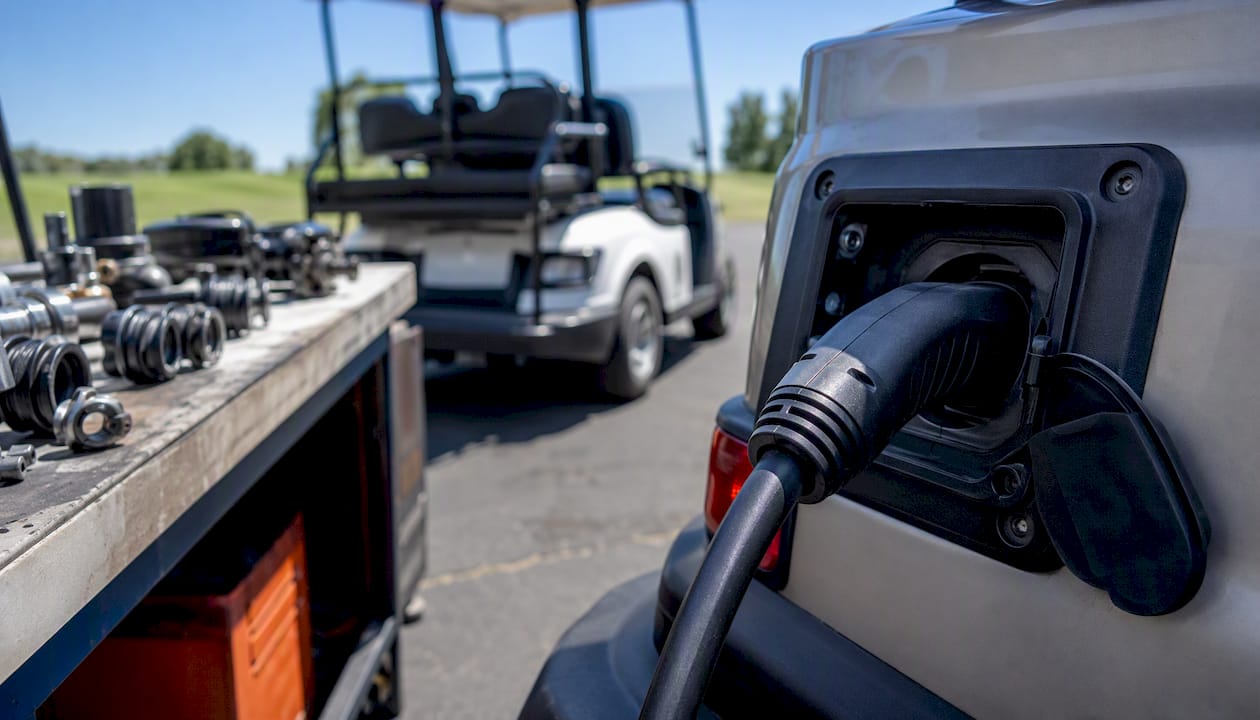
What does a kW rating mean in practice? A 3.3 kW OBC adds roughly 10–12 miles of range per hour on Level 2. An 11 kW OBC adds around 35–40 miles per hour under the same conditions. Overnight home charging on Level 2 works fine with either, but a midday top-up during a road trip is where a higher-rated OBC pays off. Aptiv notes that AC charging via the OBC is generally gentler on battery health than frequent DC fast charging, making it the better choice for daily use.
The core difference is location. An onboard charger lives inside the vehicle and handles AC-to-DC conversion. An offboard charger (a DC fast charger) does that conversion inside the charging station and pushes DC directly to the battery.
| Onboard AC Charger | Offboard DC Fast Charger | |
|---|---|---|
| Location | Inside the vehicle | Inside the charging station |
| Input to vehicle | AC | DC |
| Conversion done by | OBC in the vehicle | Station electronics |
| Typical power | 3.3–22 kW | 50–150 kW |
| Best for | Daily home/workplace charging | Long trips, fast top-ups |
| Battery wear | Lower with regular use | Higher with frequent use |
| Vehicle cost impact | Adds weight and cost to vehicle | Cost stays at the station |
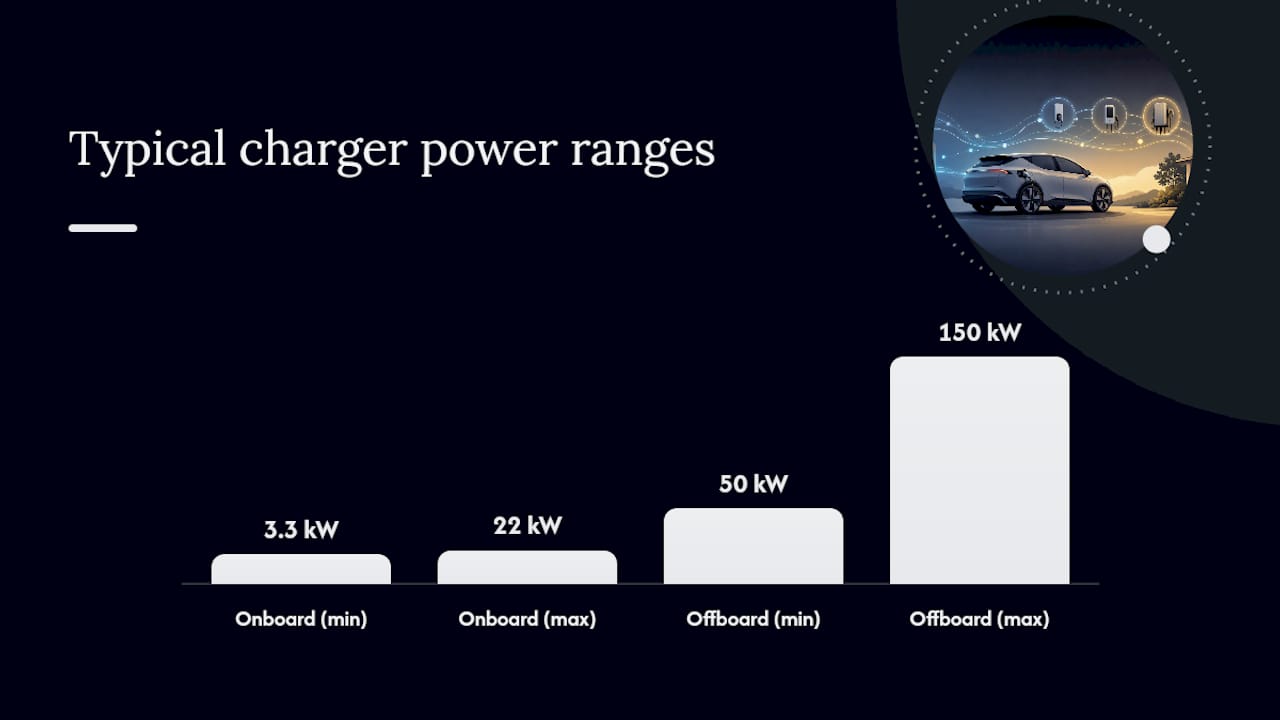
The trade-off is straightforward. Onboard AC charging is slower but adds no infrastructure cost to the station side and is kinder to the battery over time. Offboard DC fast charging is fast but shifts the expensive power electronics to the station, and frequent use at high power does accelerate battery degradation. For most owners, the practical answer is AC charging at home most nights and DC fast charging only when a trip demands it.
When a vehicle spec sheet says “11 kW onboard charger,” that number is the maximum AC power the OBC can accept. The math to convert it to current draw is straightforward: watts ÷ volts = amps.
For a single-phase 240V Level 2 circuit: power divided by voltage equals current in amps, typically requiring a 50-amp circuit for an 11 kW charger. That means you need a 50-amp circuit and a Level 2 EVSE rated for at least 48 amps continuous to actually use the full 11 kW.
Aptiv’s technical overview puts single-phase OBCs at 7.2–11 kW and three-phase units up to roughly 22 kW. Three-phase supply is standard in much of Europe and commercial settings, but most U.S. residential installations are single-phase, which caps practical home charging at 11 kW regardless of what the OBC can theoretically handle.
Two label caveats worth knowing: the kW figure is often a peak rating, and vehicle software frequently enforces a lower continuous limit for thermal or warranty reasons. If your car charges at 7.2 kW on a 10 kW-rated OBC, software throttling is the likely explanation, not a faulty charger.
OBCs include multiple layers of protection that work automatically. Overcurrent and overvoltage protection cuts power if the incoming supply exceeds safe limits. Thermal protection monitors the OBC’s own temperature and reduces current or stops charging if it runs too hot. Galvanic isolation keeps the high-voltage battery circuit electrically separated from the vehicle chassis and the AC supply. Software cutoffs from the BMS stop charging when cells reach full voltage or when temperature is outside the safe window.
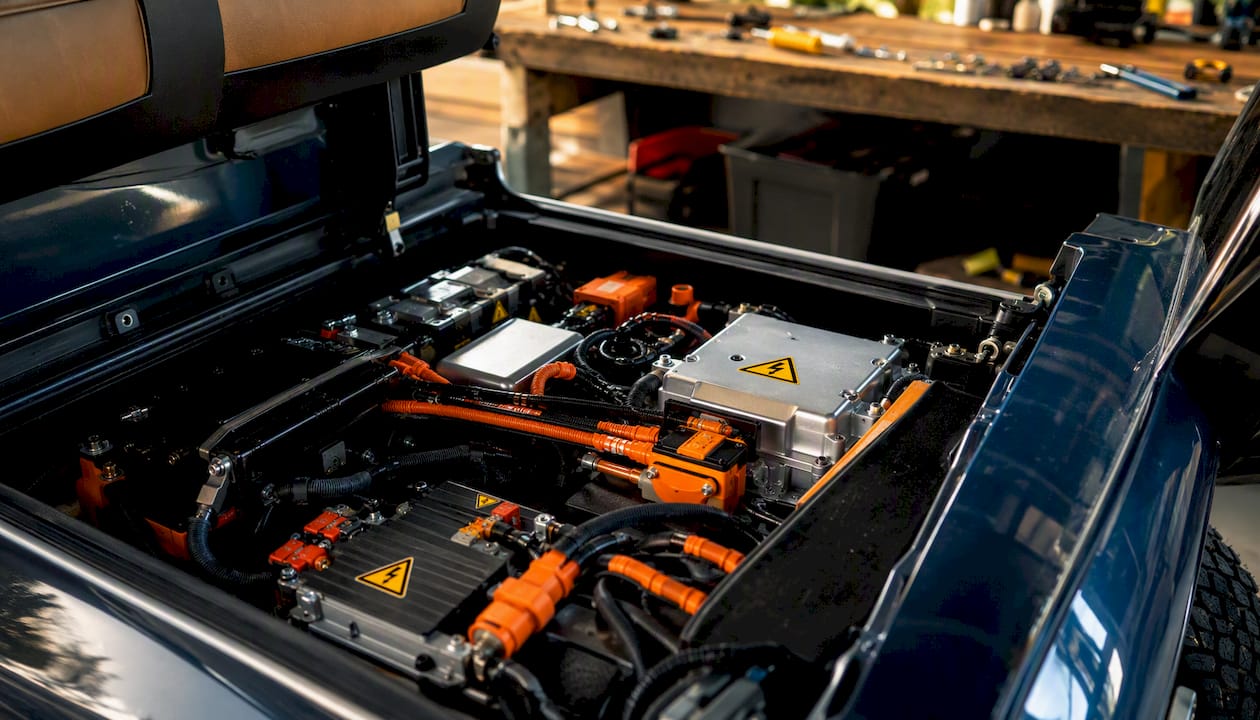
Is it safe to leave your EV plugged in? Yes, for most vehicles. Once the battery reaches its target state of charge, the OBC stops drawing current and enters a maintenance or float mode. The vehicle monitors the battery and tops it off in small increments as needed. Leaving it plugged in overnight is not only safe but often recommended, since it lets the thermal management system precondition the battery before you drive.
Owner checklist for safe charging:
Signs that need a technician: a burning smell near the charge port, persistent charging fault codes that don’t clear after a restart, the OBC getting unusually hot to the touch, or the vehicle refusing to charge on multiple different EVSEs.
The typical OBC uses a two-stage design. Stage one is an AC-DC rectifier with power factor correction. Stage two is an isolated DC-DC converter that steps the rectified voltage to the precise level the battery needs. MDPI Energies’ 2024 review confirms this two-stage architecture is standard across most production OBCs, with topology choices varying by power level and design goals.
| Topology | Common Power Range | Owner-Facing Impact |
|---|---|---|
| Vienna rectifier (PFC stage) | 3.3–22 kW | High efficiency, low harmonic distortion |
| Totem-pole PFC | 7.2–22 kW | Very high efficiency, common in newer designs |
| LLC/CLLC (DC-DC stage) | 3.3–11 kW | Low switching losses, good for unidirectional charging |
| Dual-active-bridge (DAB) | 7.2–22 kW | Supports bidirectional flow (V2G/V2L) |
Onsemi’s technical blog points out that silicon carbide (SiC) semiconductors are increasingly replacing silicon in OBC power stages. SiC switches at higher frequencies with lower losses, which means smaller passive components, less heat, and a physically smaller unit. That matters for vehicle packaging, where every kilogram and centimeter counts.
Two integration trends are reshaping OBC design. Integrated OBCs (iOBCs) share components with the motor inverter or DC-DC converter, raising power density but adding thermal and control complexity. Bidirectional OBCs using DAB or CLLC topologies enable vehicle-to-grid (V2G) and vehicle-to-load (V2L) operation, turning the OBC from a one-way converter into an energy management node.
Pro Tip: If you’re comparing EVs and care about charging speed at home, check whether the OBC is single-phase or three-phase capable. A three-phase OBC in a single-phase home installation still charges at single-phase rates, but it gives you flexibility if you ever upgrade your electrical service or charge at a three-phase commercial station.
The most common OBC-related calls come from owners who assume a slow charge means a broken charger. Nine times out of ten, the issue is either a software-throttled current limit or an EVSE that can’t deliver what the vehicle is rated for. Before assuming the OBC has failed, pull the vehicle’s charge logs or error codes. Most modern EVs log session data, and a technician can see immediately whether the OBC was limiting current or whether the EVSE was the bottleneck.
Replacing an OBC is a fundamentally different job than swapping an external charger. The OBC is integrated into the vehicle’s high-voltage system, which means it requires trained technicians, proper HV safety procedures, and often dealer-level diagnostic tools to recalibrate after replacement. Cost and parts availability vary significantly by make and model. For golf carts and light EVs, the charger algorithm and BMS settings are often the first things a tech checks before condemning the charger hardware itself.
If your golf cart’s charging system needs attention, Golfcartstuff carries chargers, lithium batteries, and electrical accessories for EZGO, Club Car, and Yamaha carts. No guessing about compatibility: the catalog is organized by make and model so you find the right part the first time.

Whether you’re replacing a worn charger, upgrading to lithium, or sourcing a replacement part after a fault, the Club Car DS parts catalog and the broader golf cart accessories section cover the most common service needs. Browse by model, check the specs against your cart’s requirements, and order direct. Golfcartstuff ships across the United States.
Explore our store to see what our products and resources can do for you.

Leave a comment