
Your Cart Is Our Priority
Explore our store to see what our products and resources can do for you.

A well-maintained golf cart can last 15 to 20+ years, while a neglected one may give out in as few as 5 years. That gap is not about luck or brand quality. It comes down entirely to how consistently you take care of the machine. Most owners treat their cart like a household appliance, assuming it will just keep running. But skipping routine checks quietly erodes performance, safety, and resale value until one expensive repair forces the issue. This guide covers the exact maintenance habits that protect your investment, keep your cart running safely, and save you thousands over the long haul.
| Point | Details |
|---|---|
| Maintenance doubles lifespan | Simple, regular upkeep allows golf carts to last 15-20+ years, or even up to 40 years for electric models. |
| Save on repairs | Annual maintenance costs far less than major repairs and protects your cart’s resale value. |
| Safety is non-negotiable | Brakes and tires must be regularly checked to prevent accidents and injury. |
| Battery care pays off | Consistent charging and proper battery maintenance prevent breakdowns and costly replacements. |
| Professional checks matter | Pairing annual professional service with DIY habits optimizes your cart’s performance and longevity. |
Let’s start with the numbers, because they tell a story most cart owners have never heard. Annual maintenance runs $200 to $600, which sounds like a real expense until you compare it to the $1,000 to $3,000+ in repairs that neglect typically triggers. That same source confirms that maintained carts retain 70 to 80% of their resale value, while neglected ones drop to just 50 to 60%. You are not just spending less. You are keeping more.
Safety is the other side of this equation, and it is serious. Neglected maintenance contributes to mechanical failures in 20% of golf cart accidents. Injuries from golf cart incidents rose 64% between 2015 and 2024, reaching roughly 26,000 per year, with rollovers accounting for 72% of serious injuries, often tied directly to worn brakes and underinflated tires. These are not freak accidents. They are preventable.
The regular maintenance benefits go well beyond avoiding breakdowns. Here is what consistent upkeep actually delivers:
| Maintenance scenario | Annual cost | Avg repair cost avoided | Resale value retained |
|---|---|---|---|
| Regular maintenance | $200 to $600 | $1,000 to $3,000+ | 70 to 80% |
| Neglected cart | $0 upfront | Paid in full | 50 to 60% |
The math is clear. Skipping maintenance is not saving money. It is deferring a larger bill. With the stakes clear, let’s break down what your maintenance routine should actually cover.
A solid maintenance routine is not complicated, but it does require consistency. Think of it in four time frames: daily, monthly, quarterly, and annual. Each layer builds on the last.
For a deeper breakdown of each step, the extended maintenance steps guide walks you through every task in detail. Professional service every 100 to 125 hours of use is the standard recommendation, and it is worth every dollar.
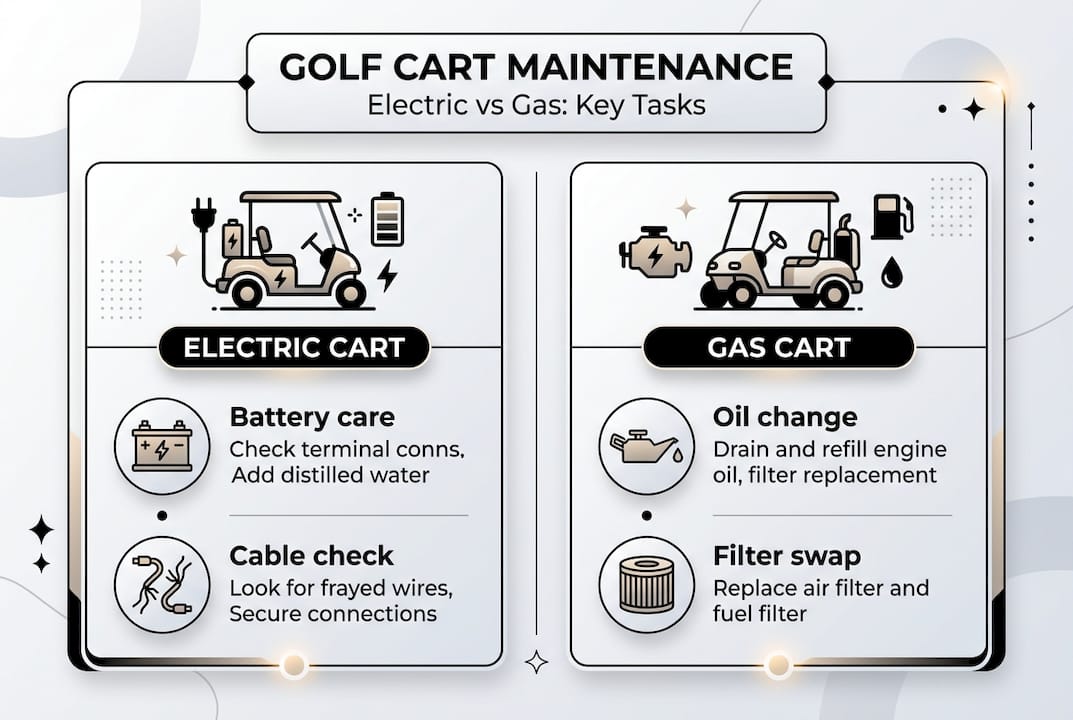
Electric and gas carts share many of the same needs, but they diverge in important ways. Understanding gas vs electric cart care helps you avoid applying the wrong routine to your model.
| Task | Electric cart | Gas cart |
|---|---|---|
| Battery care | Monthly watering, daily charging | N/A |
| Oil changes | Not required | Every 125 hours |
| Air filter | Not required | Every 6 months |
| Belt inspection | Quarterly | Quarterly |
| Fuel system check | Not required | Annually |
Pro Tip: Handle daily visual checks yourself, but leave brake adjustments, motor diagnostics, and electrical work to a certified technician. If your cart is pulling to one side or losing power on flat ground, those are signs to consult motor troubleshooting tips before the problem compounds.
Now that you know what needs to be done, let’s dig into those safety-critical inspections that are too often missed.
“Rollovers account for 72% of serious golf cart injuries, and the leading causes are worn brakes and underinflated tires. Both are entirely preventable with routine checks.”
Brakes and tires are the two systems most directly tied to accident risk, and they are also the two most commonly skipped during casual ownership. Brake inspections every 6 months are considered essential for safe operation. Most carts use mechanical drum brakes, while newer Club Car models feature self-adjusting systems that still require periodic inspection to confirm they are functioning correctly.
Here is what to check and when:
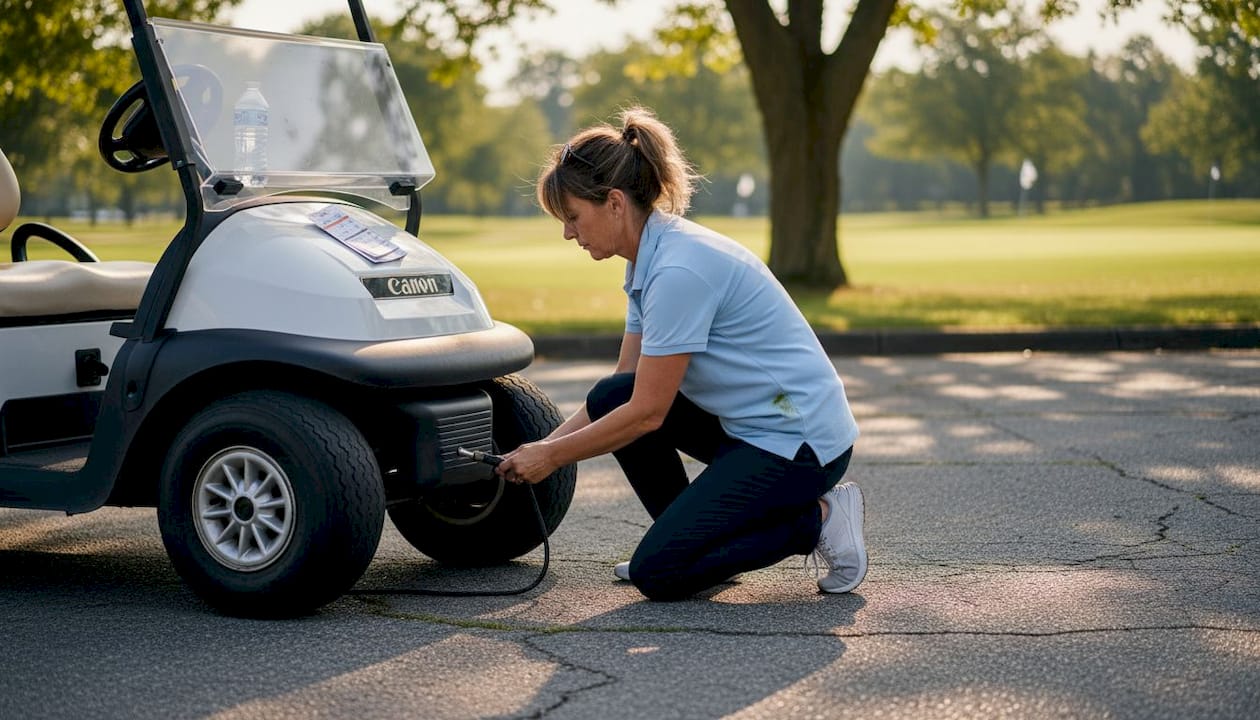
Proper tire pressure does more than prevent flats. It boosts range, reduces strain on the drivetrain, and keeps handling predictable. A tire that is just 4 PSI low can noticeably affect how the cart corners. Pair your tire checks with a look at essential safety accessories to make sure your cart is fully equipped for safe operation.
Pro Tip: Before each season, do a slow-speed brake test in an open area. If the cart pulls left or right when stopping, one brake is wearing faster than the other. Catching this early costs almost nothing to fix. Ignoring it can lead to a rollover. For hands-on guidance, the tire installation guidance resource covers proper mounting and pressure setup.
With safety-critical systems covered, do not neglect the battery, your cart’s power source.
The battery is the single most expensive component in an electric golf cart, and it is also the most sensitive to neglect. A few simple habits can double the usable life of your battery pack.
For lead-acid batteries, the rules are straightforward but non-negotiable:
Lithium batteries are far simpler. Lithium systems require no watering and handle partial charges without damage, making them a lower-maintenance option for owners who want less hands-on upkeep. Winter storage still requires a full charge before disconnecting.
Pro Tip: Never use tap water in a lead-acid battery. The minerals in tap water react with the electrolyte and shorten cell life significantly. Distilled water costs less than a dollar per gallon and protects a battery pack worth hundreds.
For gas carts, battery maintenance is minimal, but the 12V accessory battery still needs periodic checks. Explore charger maintenance tips and battery charger insights to make sure your charging setup is working efficiently. If you are deciding between voltage configurations, the battery setup guide breaks down the 36V vs 48V decision clearly.
Want to maximize the value of your maintenance investment? Let’s look at how simple, consistent effort pays off over time.
Here is the stat that should change how you think about every oil change and tire check: proper maintenance extends lifespan from 5 to 8 years without it, to 15 to 20+ years with it. Electric carts maintained well can reach 20 to 40 years of service life. That is not a minor improvement. That is potentially tripling the useful life of a vehicle you already own.
The routines with the highest long-term payoff are not the expensive ones. They are the consistent ones:
Consistent DIY tasks like these cost almost nothing individually but compound into massive savings over a decade. Buyers also pay a premium for carts with documented service history. A well-kept cart with records can command 20% more at resale than an identical model with no history. That is real money back in your pocket.
If you want a structured approach to building these habits, the extend golf cart lifespan guide gives you a step-by-step framework you can follow from day one.
Knowing what to do is only half the equation. Having the right parts and products on hand makes it easy to actually follow through. Whether you are replacing worn brake components, upgrading your tires, or stocking up on battery maintenance supplies, having a reliable source matters.
At GolfCartStuff.com, we carry parts and accessories for all the most popular models. Browse Club Car DS parts or Yamaha G1-G22 parts to find exactly what your cart needs. Our full range of golf cart accessories covers everything from safety upgrades to comfort add-ons. Use our blog guides alongside your parts order to make every maintenance session count. Your cart will last longer, run better, and be worth more when it is time to sell.
Plan for professional service every 100 to 125 hours of use, or at minimum once per year. Regular DIY checks between visits keep small issues from becoming expensive ones.
Keep tire pressure between 18 and 22 PSI and check it monthly. Correct pressure prevents uneven wear, improves range, and reduces strain on the drivetrain.
Neglected maintenance contributes to mechanical failures in 20% of golf cart accidents. Routine brake and tire checks are the most direct way to reduce your risk of a serious incident.
Charge after every use, check water levels monthly for lead-acid batteries, and store at full charge during winter. Winter storage requires a full charge and disconnecting the battery to prevent slow drain.
Absolutely. Consistent maintenance retains 70 to 80% of resale value, compared to just 50 to 60% for neglected carts. Documented service records can push that number even higher.
Explore our store to see what our products and resources can do for you.

Leave a comment