

Your Cart Is Our Priority
Explore our store to see what our products and resources can do for you.

TL;DR:
- The OBC manages battery charging, monitoring, and system safety in electric golf carts.
- Proper OBC maintenance extends battery life and prevents costly misdiagnoses.
- Differentiating the OBC from the controller is crucial for accurate troubleshooting and upgrades.
Most golf cart owners spend hundreds of dollars chasing battery or charger problems without ever checking the one component quietly managing both: the onboard computer, or OBC. This small but powerful device sits at the heart of your cart’s electrical system, yet it’s routinely misunderstood, ignored, or confused with the controller. Understanding what the OBC actually does changes how you diagnose problems, plan upgrades, and extend the life of your cart. This article breaks down exactly how the OBC works, why it matters more than most owners realize, and what practical steps you can take today to get more from it.
| Point | Details |
|---|---|
| OBC manages charging | The onboard computer regulates battery charging to boost performance and safety. |
| OBC is not a controller | Controllers handle motor functions; OBCs focus on batteries and charging. |
| Diagnosing OBC issues | Step-by-step guides help owners spot and fix common OBC problems quickly. |
| OBC upgrades available | Upgrading your OBC can extend battery life and improve cart reliability. |
The OBC, short for onboard computer, is an electronic module built into most modern electric golf carts. Its primary job is to manage and monitor the charging process. Think of it as the brain between your charger and your battery pack. It doesn’t just let electricity flow in blindly. It watches voltage, current, and temperature in real time, adjusting the charge rate to protect your batteries.
Good electrical system basics start with understanding that OBCs manage battery charging and protect electrical components across the entire system. That’s a big job. Without the OBC, your charger has no reliable way to know when the battery pack is full, what condition it’s in, or whether something dangerous is happening.
Here’s a quick look at what the OBC handles versus other key components:
| Component | Primary role | Directly controls |
|---|---|---|
| OBC | Charging and battery monitoring | Charger input and battery data |
| Controller | Motor speed and torque | Electric motor output |
| Charger | Supplying AC to DC power | Voltage and current delivery |
| BMS | Cell-level balance | Individual battery cells |
Most OBCs on electric golf carts handle these core functions:
Gas carts use different engine management systems, so OBCs are specific to electric models. Brands like Club Car, EZGO, and Yamaha all use OBCs in their electric lines, though the design and software vary between models and years.
Pro Tip: If you’re troubleshooting and unsure whether your issue is electrical or mechanical, reading the golf cart controller guide alongside your OBC manual can save you from misdiagnosing the wrong component.
With the basics covered, let’s explore the real-world advantages the OBC delivers.
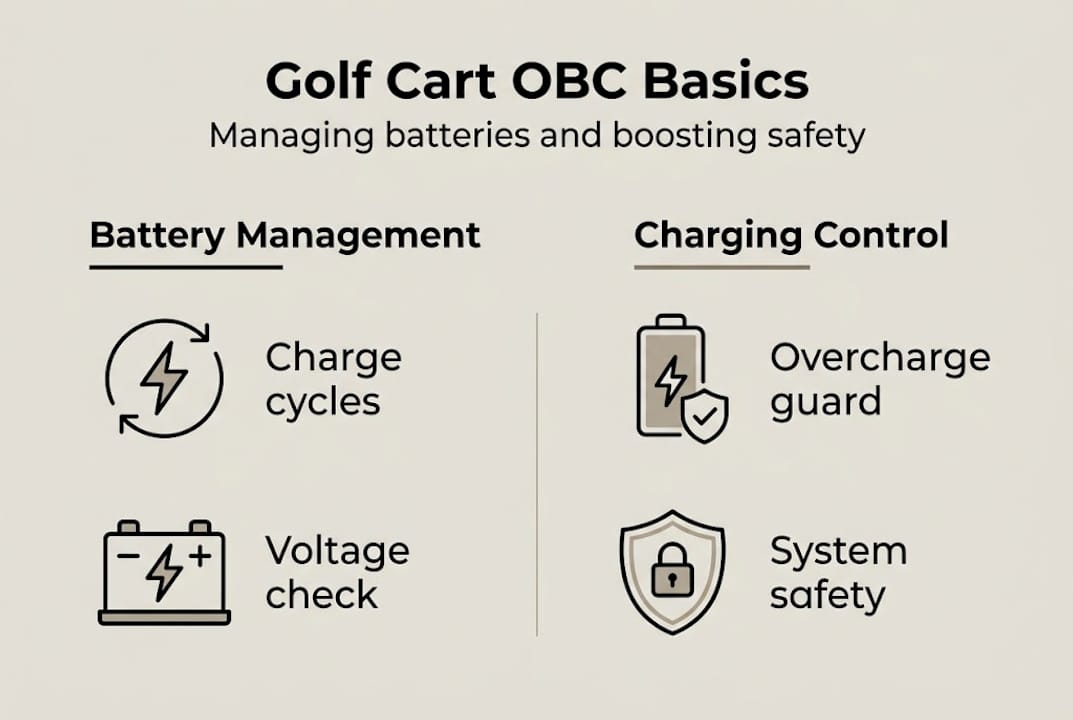
The OBC does its best work in three overlapping areas: battery management, charging control, and system safety. Each one directly affects how long your cart lasts and how well it performs on the course or road.
Battery management means the OBC constantly reads the state of your battery pack. It tracks charge cycles, voltage levels, temperature, and draw rates. Over time, this data helps the cart avoid the patterns that kill batteries early: deep discharges followed by incomplete charges, or rapid charging in hot conditions.
Charging control is where most owners feel the OBC’s impact. OBCs prevent battery overcharging, extending battery life by ensuring the charger stops at the right point. This matters because overcharging is one of the leading causes of early battery failure in golf carts. Following a solid charger maintenance guide alongside your OBC checks is smart practice.
Here’s how OBC-controlled charging compares to unmanaged charging:
| Charging type | Overcharge risk | Average battery lifespan | Cycle accuracy |
|---|---|---|---|
| OBC-managed | Low | 4 to 6 years | High |
| Unmanaged (no OBC) | High | 2 to 3 years | Low |
System safety is the OBC’s emergency role. If a short circuit occurs, temperatures spike, or voltage goes out of the safe range, the OBC shuts the system down before real damage happens. This protects not just the batteries but the entire cart’s electrical chain.
Here are the key safety events an OBC can catch and respond to:
“The OBC is the most underrated component in an electric golf cart. Owners who maintain it properly consistently see battery packs that outlast industry averages by two or more years.” — Golf cart electrical diagnostics technician
If you want to maximize battery life, checking golf cart voltage tips alongside your OBC maintenance routine gives you a fuller picture of what healthy numbers look like.
Now that you know the vital internal functions, discover how the OBC works with other key cart components.
This is where a lot of owners get tripped up. The OBC and the controller are not the same thing, and misidentifying one for the other leads to expensive mistakes.
Controllers manage motor speed; OBCs regulate battery and charging. That single sentence captures the core split, but it’s worth breaking down further because both components live inside the same cart and can produce similar symptoms when they fail.
The controller’s job starts the moment you press the accelerator. It reads the throttle input and sends the right amount of power from the batteries to the motor. Speed, torque, regenerative braking (on carts that have it): all of that is the controller’s territory. For a deeper look at how this works, the golf cart motor explained resource covers the full picture.
The OBC, by contrast, is most active when the cart is parked and plugged in. It’s managing the charging cycle, communicating with the charger, and logging battery data. Some OBCs also monitor the system during operation, but their primary responsibility is the battery side of things.
Here’s a clear comparison to keep them straight:
| Component | Active when | Failure symptom | Do NOT confuse with |
|---|---|---|---|
| OBC | Charging/plugged in | Won’t charge, battery errors | Charger or battery issue |
| Controller | Driving | No movement, speed problems | Motor or solenoid issue |
| Charger | Plugged in | No power to batteries | OBC fault |
Common misdiagnosis patterns we see:
Understanding these differences is crucial, so how can you apply this knowledge to diagnostics and upgrades?
Knowing what the OBC does is half the battle. The other half is knowing when it’s the problem and what to do about it.
Common symptoms of OBC failure:
When you see these signs, don’t reach for a new charger or new batteries yet. Regular OBC tests and resets solve most battery charging problems before any parts are replaced. That alone can save you a significant amount of money.
Step-by-step OBC diagnostic process:
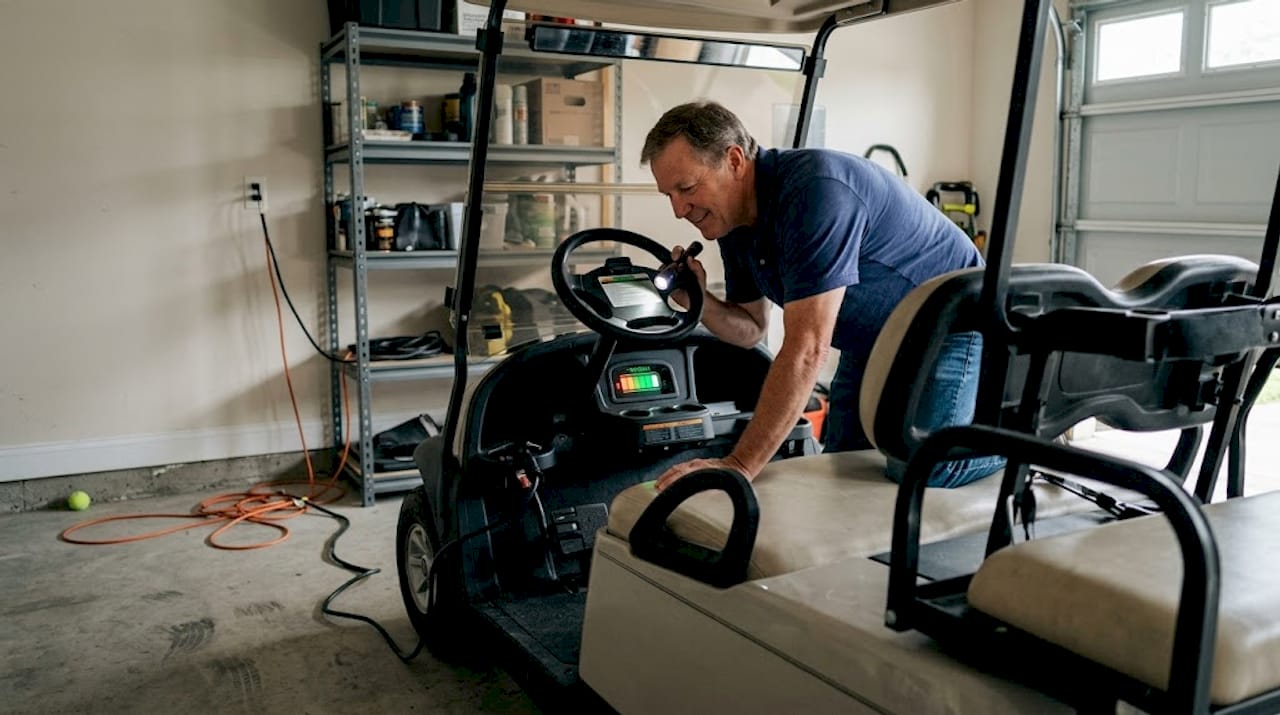
Maintenance routines that keep your OBC healthy include cleaning terminals every three months, keeping the battery bay dry and ventilated, and never letting the battery pack fully drain before recharging. Reviewing your cart’s safety inspection steps at the start of each season catches OBC issues before they escalate.
For older carts, upgrading to a newer OBC can deliver improved accuracy, better charging algorithms, and compatibility with modern lithium battery packs. A quality golf cart maintenance guide will include OBC checks as a standard part of the seasonal routine.
Pro Tip: Always check the OBC before investing in a new charger or battery pack. A faulty OBC will damage new components just as fast as old ones.
Having seen the troubleshooting steps, let’s put OBC knowledge into a broader context for golf cart owners.
Here’s the uncomfortable truth most advice overlooks: the majority of premature battery failures we see are OBC-related problems that got misdiagnosed. Owners replace battery sets, sometimes spending $800 or more, only to kill the new ones within a season because the OBC was never fixed.
Conventional wisdom says batteries die, you replace them. But the real question is why they died in the first place. In our experience with hundreds of owner cases, consistent OBC maintenance outperforms reactive repairs every single time. Carts that get regular regular golf cart maintenance including OBC checks run longer, charge more reliably, and cost less over time.
The owners who get the most from their carts treat the OBC like they treat the tires or the brakes: something that needs periodic attention, not just emergency replacement. That mindset shift is what separates a cart that lasts 10 years from one that’s constantly draining your wallet.
Once you understand your OBC, the next step is making sure you have the right parts to keep it running or replace it when needed. At GolfCartStuff.com, we carry replacement OBCs, compatible chargers, and upgrade kits for the most popular cart brands on the market.

Browse our full selection of golf cart accessories to find everything from OBC connectors to monitoring tools. If you own a Club Car, our Club Car DS parts section has model-specific components that fit right the first time. Yamaha owners can find compatible upgrades in our Yamaha golf cart parts collection. Whether you’re doing a simple reset or a full OBC replacement, we have the parts to get your cart charging right.
Look for signs like the charger shutting off immediately, a battery gauge that doesn’t move, or the cart dying quickly after a full charge. OBC tests and resets resolve most of these issues before any parts need replacing.
No, they serve completely different roles. Controllers manage motor speed; OBCs regulate battery and charging, and they are two separate components with distinct failure patterns.
Yes, many carts support OBC upgrades that improve charging accuracy and battery management. Newer OBCs also support lithium battery packs, which older units may not handle correctly. Check your electrical system basics to confirm compatibility before purchasing.
Clean all OBC connections every few months, keep the battery area dry, and schedule a full check each season. Consistent OBC maintenance is proven to outperform reactive repairs in keeping your cart reliable long-term.
Explore our store to see what our products and resources can do for you.

Leave a comment