

Your Cart Is Our Priority
Explore our store to see what our products and resources can do for you.

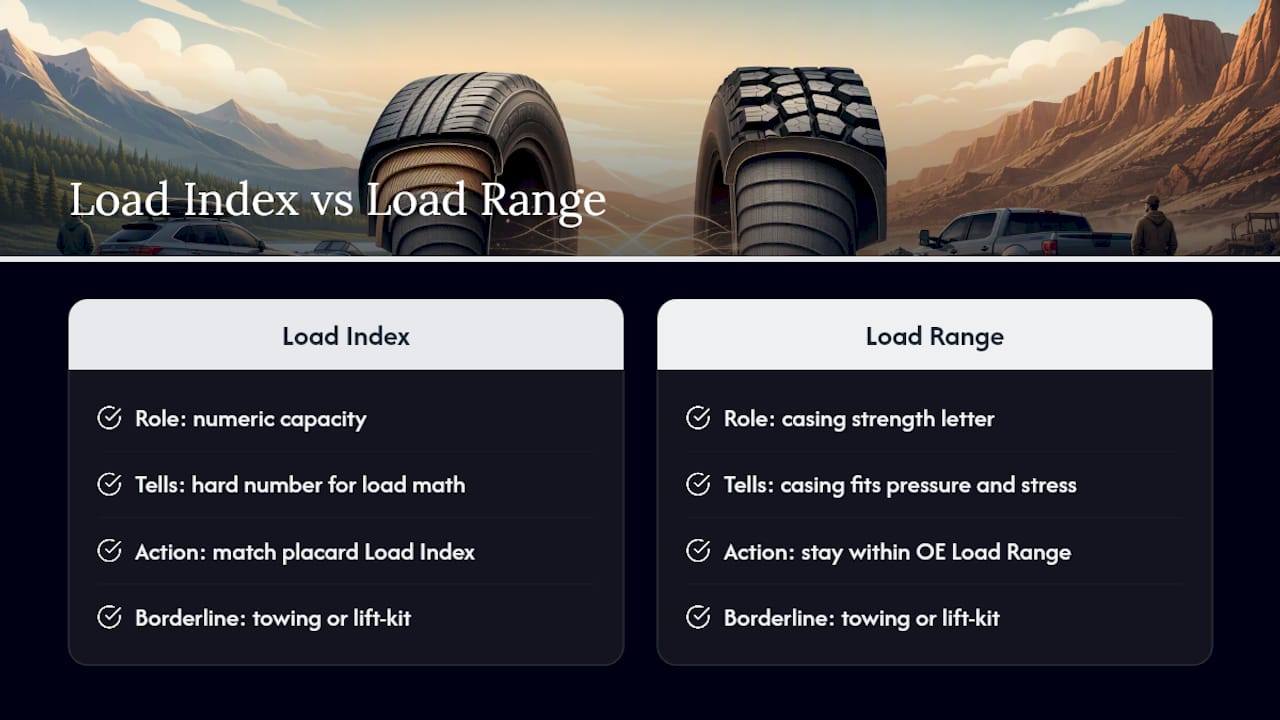
A tire’s ply rating tells you how strong its casing is and how much inflation pressure it can safely handle. That strength rating determines the tire’s load class, which is why two tires of the same size can carry very different weights. The number you actually need for precise load math is the Load Index (a two- or three-digit number on the sidewall). The Load Range letter (C, D, E, and so on) tells you the casing strength tier and the maximum cold PSI. Together, they answer one question: can this tire safely carry your vehicle’s weight?
Tire ply rating (Load Range) is a casing strength equivalency, and Load Index is the precise per-tire capacity number. Both must meet your vehicle’s requirements before you buy.
| Point | Details |
|---|---|
| Ply rating is an equivalency | A “10-ply” tire may have 2–3 actual plies; the rating reflects combined casing strength, not a literal count. |
| Load Index sets the capacity floor | The Load Index number must meet or exceed the vehicle placard figure — no exceptions. |
| Inflating past max PSI adds no capacity | Casing structure limits safe load; over-inflating a lower-rated tire does not make it a higher-rated one. |
| Higher ply rating has tradeoffs | Stiffer ride, altered wear, and handling changes on lightly loaded vehicles — match rating to actual use. |
| Golfcartstuff for golf-cart fitment | Golfcartstuff’s load and speed rating guides help golf-cart owners match tire specs to their cart’s payload and wheel size. |
The phrase “ply rating” dates to an era when tires were built from layers of cotton fabric. A 6-ply tire literally had six cotton layers. Modern radial tires replaced that construction with polyester, nylon, and steel belts. A tire today might use two or three polyester plies and still carry a “10-ply equivalent” rating because the combined strength matches what ten cotton layers once delivered. As The Tire Reviews explains, ply rating is now an equivalency index, not a literal count.
That shift matters for how you read a sidewall. The industry, standardized by the Tire and Rim Association (TRA), moved to a lettered Load Range system to reduce confusion. Load Range C means 6-ply equivalent; Load Range E means 10-ply equivalent. The letter signals casing strength and the maximum cold inflation pressure the tire can safely hold. The Load Index number alongside it gives the precise weight each tire can carry at that pressure. Discount Tire’s load range guide draws this distinction cleanly: Load Range is about casing strength and max PSI; Load Index is about exact carrying capacity.
The critical rule: you cannot safely increase a tire’s load capacity by inflating it beyond its rated max PSI. The casing design, bead structure, and sidewall strength set the ceiling. Pumping more air into a lower-rated tire does not make it a higher-rated tire.
Standard passenger tires are typically rated Standard Load (SL) or Extra Load (XL), both roughly 4-ply equivalent. Light truck and trailer tires use the lettered Load Range system, starting at C and climbing to G and beyond for the heaviest applications.
Take a real sidewall code: LT265/70R17 121/118Q E
Load Index 121 converts to roughly 3,197 lb per tire. For a truck running four of these tires in a standard configuration, the total rated capacity is approximately 4 × 3,197 = 12,788 lb. Check that against the vehicle’s Gross Vehicle Weight Rating (GVWR) on the door-jamb placard. If the GVWR falls below that number, the tires are adequate. If you regularly load the truck near its GVWR and tow on top of that, a higher Load Range may be warranted.
The table below maps common Load Ranges to their ply equivalents and typical max cold PSI. Exact per-tire capacity still depends on the specific tire size and its Load Index, so always cross-reference the tire’s own load table.
Source: Tire Ply Rating and Load Range Explained
Pro Tip: Always verify the load table for your exact tire size and consult the vehicle door-jamb placard before changing Load Range or Load Index. The placard is the legal minimum — never go below it.

No. Matching the rating to your actual use is what matters, and Trilli Tires makes this point directly: higher ply ratings are not universally better because the right choice depends on what the vehicle actually carries.
Benefits of stepping up:
Tradeoffs to weigh:
The safety risk runs in both directions, but under-rating is the dangerous one. Running tires with a lower Load Index than your vehicle’s placard requires puts the casing under stress it was never designed to handle. Heat builds inside the tire, the structure weakens, and the result is a blowout, often at highway speed. Tire Advise’s ply chart guide notes that the industry standardized load-range equivalency specifically to prevent drivers from guessing at these limits.
Over-specifying is mostly a comfort and handling issue, not a safety crisis. A Load Range E tire on a compact sedan that never hauls anything will give you a rough ride and uneven wear. Not dangerous, but wasteful.
Pro Tip: If you tow a trailer, check the trailer’s tongue weight and total loaded weight separately. Trailer tires use ST (Special Trailer) sizing with their own load ratings, and the tow vehicle’s rear tires carry a disproportionate share of the tongue load.
Read the door-jamb placard. The sticker inside the driver’s door lists the required tire size, Load Index, and recommended inflation pressure. That Load Index is your floor, not a suggestion.
Verify the tire’s Load Index meets or exceeds the placard. A tire with LI 118 on a vehicle requiring LI 121 is undersized for the job. The number must match or beat the placard figure.
Check the Load Range letter if you tow or haul regularly. For a half-ton truck used mostly for commuting, Load Range C or D is often sufficient. For a three-quarter-ton truck towing a fifth-wheel trailer, Load Range E is the standard choice. Consult a vehicle classes guide if you are unsure which GVWR band your vehicle falls into.
Match tire class to use. P-metric tires (SL/XL) suit passenger cars and light crossovers. LT tires suit trucks, SUVs with towing packages, and vans carrying heavy cargo. ST tires are for trailers only and should never go on a tow vehicle.
Watch for red flags. A tire with a lower Load Index than the placard, a mismatched tire class (LT on a vehicle specced for P-metric without a load reason), or missing load-range markings on a required LT application are all reasons to stop and reconsider before purchasing.
Golf-cart tires follow the same underlying logic, but the labeling looks different. Most golf-cart tires list a maximum load per tire and a maximum PSI directly on the sidewall rather than using the LT Load Range letter system. The ply-equivalency concept still applies: a tire with a higher ply rating or a higher max PSI has a stronger casing and can carry more weight.
For golf-cart owners: when you add a lift kit, larger wheels, or plan to carry extra passengers and cargo regularly, the tire’s sidewall strength becomes more important. A tire rated for a light factory load may not be adequate once the cart is modified. Check the max load per tire against the total expected weight of cart, passengers, and cargo before buying.
Practical checks for golf-cart fitment: confirm the tire’s listed max load per tire, match the wheel diameter exactly, and verify the max PSI suits the cart’s loaded weight. Golfcartstuff’s golf-cart tire speed and load rating list is a useful starting point for comparing specs across common sizes. For a broader fitment reference, the Ultimate Wheel & Tire Guide covers sizing, load, and compatibility for EZGO, Club Car, and Yamaha carts.
Both Load Index and Load Range belong in every tire-buying decision. The Load Index gives you the hard number for load math; the Load Range letter tells you whether the casing is built for the pressure and stress your application demands. Checking only one of them is how drivers end up with tires that technically fit the rim but fail under load.
For most daily drivers, matching the placard Load Index and staying within the OE Load Range is all that is needed. If your use case is borderline, such as a truck that sometimes tows near its rated limit or a golf cart running a heavy lift kit, contact a retailer or mechanic who can look at the specific application. Getting it right costs nothing extra; getting it wrong costs a blowout.
Golf-cart tire specs are narrower than most drivers realize. The difference between a tire that handles a lifted cart with four passengers and one that fails under that load often comes down to a single line on the sidewall. Golfcartstuff stocks tires and wheel-tire combos for EZGO, Club Car, and Yamaha carts, with load and speed ratings listed on every product page so you can verify the fit before you buy.
Whether you need a set of 10" wheel and tire combos for a lifted cart or replacement tires matched to your Club Car’s factory specs, Golfcartstuff carries the parts with the fitment data attached. Browse the full Club Car DS parts catalog or the Yamaha G1–G22 parts section to find tires sized and rated for your specific cart. If the application is borderline, the product pages include max load and PSI specs, and the support team can confirm compatibility before your order ships.
The sources below are the primary references used in this guide. Each covers a specific aspect of load-range and load-index lookup in more depth.
Reminder: load tables published by the Tire and Rim Association (TRA) give the authoritative per-size capacity figures. Always cross-reference the specific tire’s load table and your vehicle’s door-jamb placard before finalizing a purchase.
Explore our store to see what our products and resources can do for you.

Leave a comment