

Your Cart Is Our Priority
Explore our store to see what our products and resources can do for you.

Underseat storage on a golf cart gives you hidden, weather-protected space for valuables, tools, and small gear while also helping keep the battery area clear of debris and moisture. Before you order any tray or drawer, two things decide whether it fits: your cart’s model family (EZGO, Club Car, or Yamaha) and your battery type (lead-acid vs. lithium).
Quick calls:
Underseat storage on a golf cart provides hidden, weather-protected organization while keeping the battery area cleaner and easier to maintain, but only when the tray matches your cart model and battery type.
| Point | Details |
|---|---|
| Core purpose | Underseat trays provide concealed, weather-protected storage for valuables, tools, and small gear on open carts. |
| Compatibility first | Confirm cart model, year, and battery type (lead-acid vs. lithium) before ordering any tray or drawer. |
| Weight limits | Most plastic trays handle 10–30 lb; heavier hauling needs a rear cargo box rated for 150–300 lb. |
| Battery area protection | A fitted tray reduces debris and moisture reaching battery terminals, supporting easier maintenance. |
| Golfcartstuff | Stocks model-specific trays for EZGO, Club Car, and Yamaha with fit notes; contact support for photo-based fit verification. |
The core job is simple: turn dead space above the battery pack or motor into usable, concealed storage. Golf carts are open vehicles. Anything sitting in a front basket or on a rear rack is visible, exposed to rain, and easy to grab. A tray or drawer tucked under the seat solves all three problems at once.
Who actually uses them:
Beyond organization, there’s a maintenance angle most owners overlook. A tray sitting above the battery bank acts as a partial barrier, limiting how much dirt, grass clippings, and moisture reach the terminals directly. Keeping the battery area free of clutter and debris is one of the simplest ways to extend battery life, and a fitted tray helps enforce that habit passively.
Weight limits matter here. Trays in the 10–30 lb range cover most everyday use cases. Push past that and you risk cracking the tray or stressing the seat frame. If you’re hauling tools, fertilizer bags, or anything heavy, a rear cargo box rated for 150–300 lb is the right call.
Pro Tip: Label a small pouch inside the tray for emergency items (a spare fuse, a tire inflator, a basic first-aid kit). On a course or a large property, that two-minute prep saves a long walk back to the clubhouse.
Fit problems are the number-one reason for returns on underseat storage. They almost always trace back to two things: the seat frame geometry and the battery configuration underneath.
Step-by-step measurement checklist:
Callout: Switching to lithium changes the rules. Replacing lead-acid batteries with LiFePO4 packs can free under-seat space by reducing battery height and weight, but the new pack’s dimensions must be confirmed against any tray you plan to order. Never assume the original tray spec still applies after a battery swap.
Once you’ve confirmed fit, four criteria separate a good buy from a frustrating one.
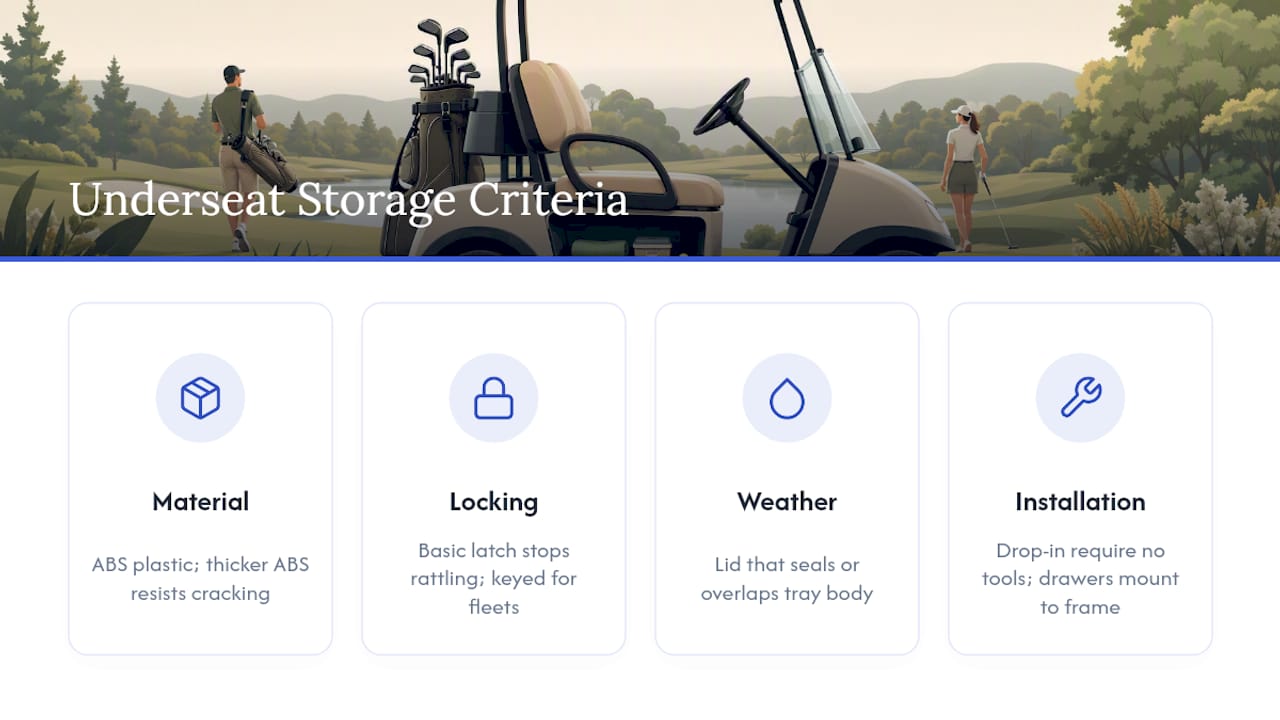
Material: Most trays are ABS plastic, which handles moisture well and stays light. Thicker ABS resists cracking under load better than thin-wall versions. Metal trays exist but add weight and can corrode if the battery area gets wet.

Locking: A basic latch keeps the tray from rattling open on rough terrain. A keyed lock makes sense for resort or rental fleets where multiple drivers use the same cart. For personal use, a latch is usually enough.
Weather resistance: Look for a lid that seals or overlaps the tray body. Open-top trays let water pool if the cart sits outside in rain.
Installation: Drop-in trays that require no tools are the easiest option for owners and dealers alike. Drawer-style units that mount to the seat frame take more time but offer better security and a cleaner look.
For dealers: Stock at least one common-fit tray for each major model family you sell or service. Offering a measurement guide to customers at point of sale cuts return rates sharply. A broader upgrade checklist can help you frame storage as part of a complete cart setup rather than an afterthought.
Most drop-in trays take under ten minutes. Drawer-style mounts take longer but follow the same basic sequence.
Install steps:
Maintenance:
Pro Tip: Keep a small microfiber cloth in the tray itself. It takes up almost no space and makes it easy to wipe down terminals during your regular checks without hunting for a rag.
Tools you’ll need: A Phillips screwdriver, a tape measure, and a flashlight. That covers most installs.
Underseat trays are the right call for hidden, weather-protected storage of light items. They’re not always the best answer. Comparing storage options helps you match the solution to the actual need.
Skip the underseat tray if your cart has a nonstandard battery that leaves no usable clearance, or if your primary need is hauling volume rather than securing small items.
Golfcartstuff stocks model-specific under-seat trays and drawers for the three major cart families. Accessories in this category typically run $30–$150 depending on whether you’re buying a basic drop-in tray or a drawer-style unit with a locking lid.
On the battery side, Redway Power LiFePO4 packs are one example of a lithium option that can free under-seat space by reducing battery height. That said, always confirm the new pack’s exact dimensions against your chosen tray spec before ordering both together.
Dealers should stock at least one tray per model family and keep a printed measurement sheet at the counter. It prevents misorders and builds customer confidence.
Run through this before you click buy:
Most fit problems are avoidable, and they almost always come down to one skipped step: measuring before ordering. The model-year information on a sticker inside the cart takes thirty seconds to find, and a tape measure takes another two minutes. Dealers who build a simple one-page measurement sheet for their three most common cart models eliminate the bulk of their storage-related returns.
The battery-type question is where things get genuinely complicated. A cart that’s been upgraded to lithium may look identical to a stock unit from the outside, but the under-seat geometry can be completely different. The safest approach is to photograph the open seat cavity with the battery pack visible and share that photo with whoever is helping you select a tray. Golfcartstuff’s team handles exactly these questions regularly, and getting that confirmation before purchase is far less painful than a return.
One more thing dealers often miss: pairing a tray recommendation with a broader cart setup conversation. Storage is rarely the only upgrade a customer wants. Framing it alongside common cart modifications turns a $40 tray sale into a complete upgrade conversation.
Golfcartstuff carries model-specific under-seat trays, drawers, and accessories for EZGO, Club Car, and Yamaha carts, with fit notes built into each product listing so you’re not guessing.

Start with the golf cart accessories collection if you’re not sure which tray fits your cart, or go directly to the Club Car DS parts page or Yamaha G1–G22 parts page for model-specific options. If you have a photo of your under-seat cavity and aren’t sure what fits, contact Golfcartstuff’s customer support team before ordering. Getting the right tray the first time is faster than processing a return.
Explore our store to see what our products and resources can do for you.

Leave a comment