
Your Cart Is Our Priority
Explore our store to see what our products and resources can do for you.

TL;DR:
- Most golf cart owners mistakenly believe towing is as simple as hooking on a trailer, risking costly damage. A proper flat towing setup involves a tow bar, baseplate, safety cables, and wiring, with correct installation and cart electronics considerations. Ensuring the Tow/Run switch is in “Tow” before towing is critical to prevent electronic damage, especially for electric carts.
Most golf cart owners assume towing their cart is as simple as tying it to a bumper or throwing it on a flatbed. That assumption gets expensive fast. Understanding what is a golf cart tow bar is the first step toward protecting your cart from serious and avoidable damage. Flat towing involves specific hardware, precise installation, and for electric carts, a critical electronic control step that most guides bury in a footnote. This article walks you through how tow bars work, how to install one correctly, and what happens when you skip the steps that actually matter.
| Point | Details |
|---|---|
| Tow bar defined | A golf cart tow bar lets you flat tow your cart with all wheels on the ground using a frame-mounted hitch. |
| Electric cart controls | Flip the Tow/Run switch to ‘Tow’ to prevent motor controller damage when towing electric carts. |
| Safety essentials | Always use secondary safety cables and wiring for lights along with proper hitch installation. |
| Modular kits | Most tow bar setups use standard receivers and removable mounts for flexibility across carts. |
| Complete checks | Perform a thorough pre-tow inspection of connections, pins, wiring, and switch settings every time. |
A golf cart tow bar is a towing connector and hitch setup for flat towing that attaches to the cart’s frame and connects to the towing vehicle while keeping all four wheels on the ground. That last part is what separates flat towing from trailer towing. Your cart rolls on its own wheels behind the tow vehicle, no ramps, no trailer deck, no straps over the tires.
The physical connection starts at a baseplate mounted to the golf cart’s frame. Tow bar arms extend from that baseplate and connect to the tow vehicle’s hitch receiver. Most systems are self-aligning, meaning the arms adjust as you maneuver before they lock rigid once you’re moving forward. Safety cables and a wiring harness for brake lights and turn signals complete the system.
Here is what a typical golf cart tow bar setup includes:
Flat towing preserves cart tires and suspension from the loading stress of a trailer, but it demands the right equipment from the start. You can learn how to install a tow bar baseplate to get a feel for how the frame attachment works on your specific cart model.
Now that we understand the basic concept of a golf cart tow bar, let’s examine how these systems must be installed and used safely.
Installation is where most towing problems begin. Skipping steps or doing them out of order creates weak points that only show up at 45 mph on a highway. The tow bar installation process includes mounting a baseplate on the towed vehicle, connecting tow bar arms to the baseplate, attaching safety chains crosswise, wiring the lighting harness, and completing a final safety check before moving.
Follow these steps in order:
You should also review a golf cart safety inspection guide before your first tow to catch any pre-existing mechanical issues that towing stress will make worse.
Key equipment that often gets overlooked:
Pro Tip: Always use pin clips and secondary safety chains even if the main latch feels secure. Vibration over long distances can work a pin loose far more easily than most people expect.
Having discussed what a tow bar is and how to install one, let’s now explore special considerations for electric golf carts during towing.
Electric carts introduce a risk that hardware alone cannot solve. When you flat tow an electric golf cart with the switch left in “Run,” the wheels spinning on the road turn the motor like a generator. That feedback current cycles through the motor controller with nowhere useful to go. The controller overheats. In many cases it fails completely. A replacement controller can cost several hundred dollars.
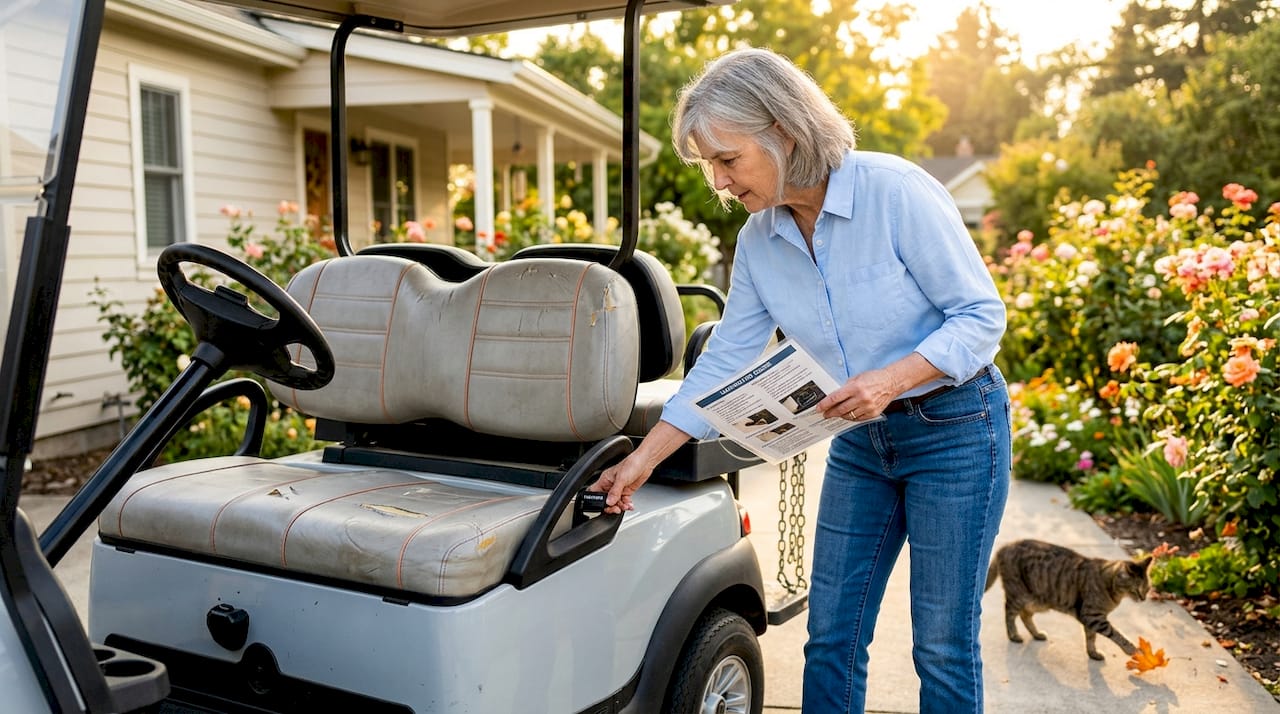
The fix is a single switch. Electric golf carts require setting the Tow/Run switch to “Tow” before flat towing to prevent overheating and damaging the electronics. On most Club Car and Yamaha electric models, this switch is located near the battery pack or under the seat. It is a small toggle, easy to miss, and easy to forget.
The steps for electric carts before towing:
“This is arguably the most important step if you have an electric cart. Leaving it in ‘Run’ will cook the electronics.” — How to Tow a Golf Cart Safely
Understanding electric cart towing laws in your state is equally important, since some jurisdictions have rules about how electric vehicles can be moved on public roads. Review those before you head out.
Pro Tip: If you feel any resistance when you begin to tow, stop immediately. Do not power through it. That resistance usually means the switch is still in “Run” or the cart is not in neutral. Continuing will damage the motor controller within minutes.
Understanding electric carts’ electronic needs clarifies why towing golf carts safely involves more than just hardware. Next, we’ll compare different tow bar and hitch setups to fit various carts and towing vehicles.
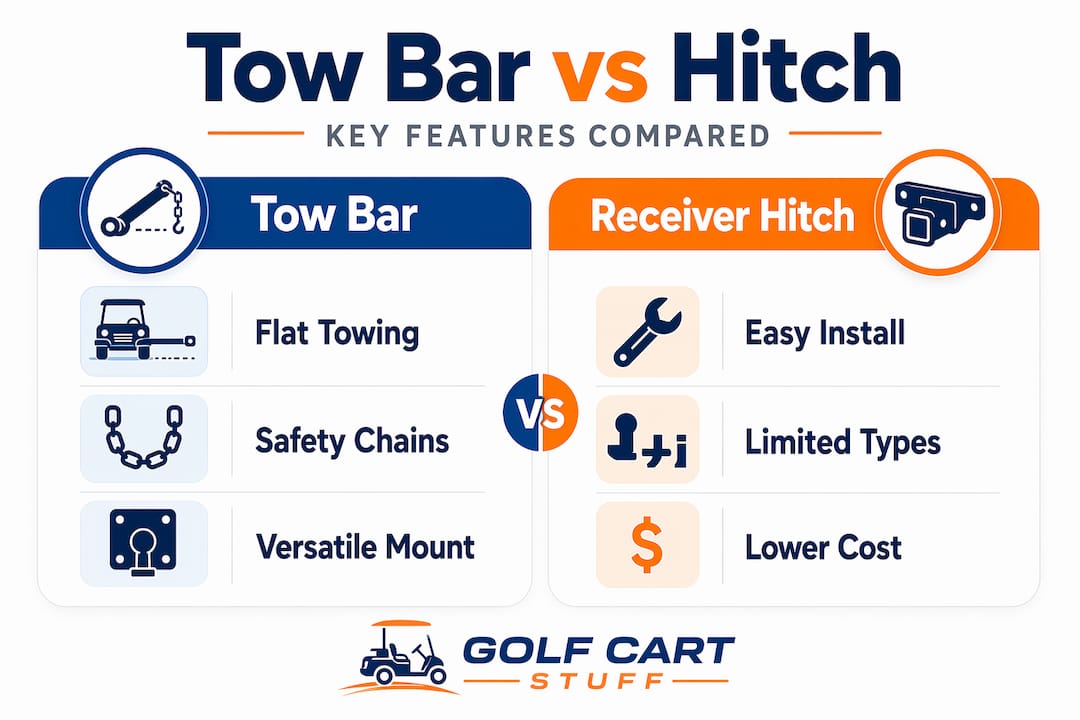
Not all tow bar systems are the same, and the differences matter for both safety and everyday convenience. Most practical golf cart towing conversions use receiver-based systems with modular components for interchangeability and safety. Here is how the three main options compare:
| System type | Installation complexity | Flexibility | Safety features |
|---|---|---|---|
| Receiver hitch only | Low | Limited (trailer use only) | Basic pin retention |
| Ball mount | Low to medium | Moderate (trailers, some accessories) | Pin and clip, no safety chain standard |
| Full tow bar kit | Medium to high | High (flat towing, lighting, chains) | Safety cables, wiring harness, locking pins |
What this table makes clear is that the best golf cart tow bar setup for flat towing is a full kit. Ball mounts are fine if you are pulling a small utility trailer behind your cart for hauling gear. But if you want to flat tow the cart itself behind a truck or SUV, you need the arms, cables, and wiring that come with a complete system.
Key things to look for when selecting a system:
Use the towing safety checklist to verify your chosen setup meets the requirements for your specific cart before buying.
This comparison equips you to choose the right hardware, but safety is always the priority. Next we’ll cover essential safety protocols you must follow when towing your golf cart.
Good hardware installed badly is still dangerous. Tow bar systems require secondary safety cables and thorough pre-trip inspection to ensure secure latches and prevent accidents. This is not a suggestion. In most states it is a legal requirement, and enforcement on this has increased as golf carts have become more common on public roads.
Critical safety practices to follow every single time:
Proper golf cart lighting and signals are a legal requirement when towing on public roads in most states, not just a courtesy to other drivers. Review golf cart towing laws for your specific state before your first road trip.
Pro Tip: Before every tow, do a slow 10-foot pull in a parking lot and then stop. Get out and check every connection point. Road vibration from even that short distance will reveal any loose hardware before you get into traffic.
Here is something most buying guides will not tell you directly. The hardware is the easy part. Tow bar arms, baseplates, safety cables, receiver hitches — these are all just bolts and steel. You can learn to install them correctly in an afternoon. The part that actually destroys golf carts, specifically the part that generates expensive repair bills, is the electronic control state of the cart at the moment towing begins.
Overlooking the Tow/Run switch exact position is a frequent cause of damage during towing, and it happens precisely because owners assume the hardware setup is the entire job. You bolt on the tow bar, you check the cables, you connect the wiring, and then you drive away with the switch still in “Run.” The cart looks fine. It tows smoothly. And somewhere on that drive, the controller quietly fries.
The physical connection and the cart’s electronic control state are equally important. Neither one protects you without the other. A perfectly installed tow bar on a cart with the wrong switch position is not a safe towing setup. It is a slow-motion equipment failure.
This matters even more because most tow bar guides are written primarily about trucks and cars, not golf carts. They cover the hardware thoroughly and mention nothing about the Tow/Run switch, because full-size vehicles do not have one. Owners reading those guides come away confident they have covered everything. They have not.
Do your tow bar installation carefully. Respect the manufacturer’s instructions for your specific cart model. And before you pull out of your driveway, flip that switch.
You have done the homework. Now get the right parts to match it.
At Golf Cart Stuff, we carry golf cart towing accessories including complete tow bar kits, baseplates, safety cables, wiring harnesses, and everything you need for a legal and reliable towing setup. Whether you drive a Club Car, a Yamaha, or another major brand, we stock compatible parts so you are not guessing at fit. Browse Club Car DS parts or Yamaha golf cart parts to find components matched to your exact model. Our team can help you identify the right baseplate size, receiver type, and wiring kit for your towing vehicle so your first tow goes safely.
A golf cart tow bar is used for flat towing your cart with all wheels on the ground, connecting the cart’s frame securely to a towing vehicle for transport on roads.
No. Towing without Tow mode active can overheat and destroy the motor controller, which is a costly repair that is entirely avoidable with one switch flip.
Safety chains crossed beneath the tow bar and a properly connected lighting harness are both essential. Secondary safety cables and wiring are also legal requirements in most states.
Most kits use standard receiver sizes and pin retention for broad compatibility, but you should always verify the baseplate fits your specific cart’s frame before purchasing.
Flat towing can reduce tire and suspension wear compared to trailer loading, but it requires proper hardware and electrical preparation that trailer towing does not. For occasional use, a trailer is simpler. For regular transport, a tow bar setup pays off.
Explore our store to see what our products and resources can do for you.

Leave a comment